
Filter Manufacturer in India
Fiilters is a filter manufacturer and supplier in India, manufacturing air filtration products for HVAC, industrial, commercial, automotive, healthcare and air purification applications.
Our product range includes HEPA filters, bag filters, pre-filters, carbon filters, high-temperature filters, medical filters, cabin filters, generator air filters and other custom filtration solutions.
We supply standard and custom filters to businesses, contractors, OEMs, hospitals, industries and other customers across India.
What Does a Filter Manufacturer Do?
A filter manufacturer designs, manufactures, assembles and tests filtration products according to specified performance and application requirements.
Depending on the product, we provide standard or custom dimensions, filter media, frame materials, configurations and documentation.
Working directly with a manufacturer makes it easier to discuss custom requirements, bulk supply and technical specifications.
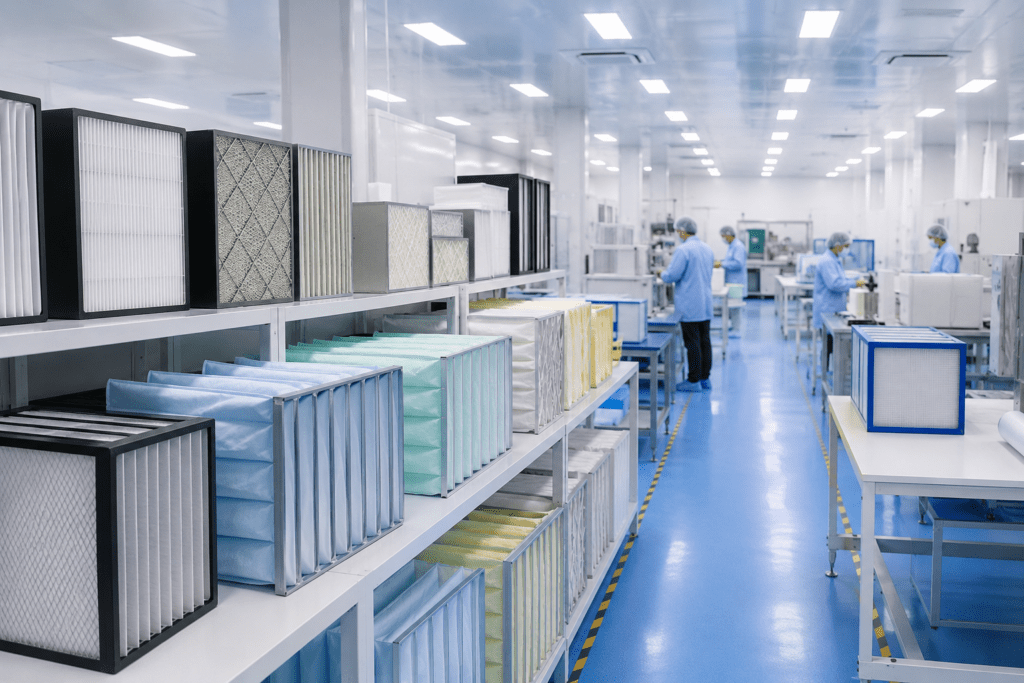
Filter Manufacturing & Supply Across India
Fiilters manufactures and supplies filtration products for customers across India. Our Delhi-based manufacturing facility supports standard products, custom requirements and bulk orders.
We work with HVAC contractors, industrial businesses, hospitals, commercial facilities, air purifier companies, automotive customers and other organizations that need filtration products.
Our Filter Product Range
HEPA Filters
High-efficiency filters for applications requiring fine particulate filtration.
Applications: HVAC, healthcare, cleanrooms, laboratories, air purification
[Learn more → https://fiilters.com/hepa-filters/]
Bag Filters
Bag filters for industrial air filtration and dust collection applications.
Applications: Cement, steel, textile, chemical, food processing, industrial plants
[View Bag Filters → https://fiilters.com/bag-filters/]
Pre-Filters
Pre-filtration products designed to capture larger particles before air reaches finer filtration stages.
Types: Panel filters, roll filters, pocket filters
[View Pre-Filters → https://fiilters.com/pre-filters/]
Carbon Filters
Activated carbon filters for odour, VOC and gaseous contaminant control.
Applications: Air purification, commercial kitchens, laboratories, industrial applications
[View Carbon Filters → https://fiilters.com/carbon-filters/]
High Temperature Filters
Specialized filtration products for applications involving elevated operating temperatures.
Applications: Furnaces, kilns, industrial processes, hot-air applications
[View High Temperature Filters → https://fiilters.com/high-temperature-filters/]
Medical Filters
Filtration products for healthcare and controlled environments, built to the required application and specification.
Applications: Hospitals, healthcare facilities, laboratories, controlled environments
[View Medical Filters → https://fiilters.com/medical-filters/]
Cabin Filters
Automotive cabin air filters designed to filter air entering the passenger compartment through the vehicle HVAC system.
[View Cabin Filters → https://fiilters.com/cabin-filters/]
Generator Air Filters
Air intake filtration products for diesel generators and other engine applications.
[View Generator Filters → https://fiilters.com/generator-air-filter/]
Industrial Air Filters
Custom and standard filtration solutions for industrial equipment, HVAC and manufacturing environments.
[View Industrial Filters → https://fiilters.com/industrial-air-filter/]
Blower & Compressor Filters
Filtration products for blower and compressor air intake and related applications.
[View Blower Filters → https://fiilters.com/blower-air-filter/] [View Compressor Filters → https://fiilters.com/air-compressor-filter/]
HEPA Filter Manufacturer
We manufacture and supply HEPA filters for HVAC, healthcare, cleanroom, laboratory and air purification applications. H13 and H14 configurations are available according to application and project requirements.
[Read the Complete HEPA Filter Guide → https://fiilters.com/hepa-filters/] [H13 vs H14 HEPA Filters → https://fiilters.com/hepa-13-filter/]
Custom Filter Manufacturing
Not every filtration system uses a standard filter size. Fiilters manufactures filters according to customer-provided dimensions, drawings and application requirements.
Custom options include:
- Filter dimensions
- Filter depth
- Media type
- Filter grade
- Frame material
- Gasket configuration
- Sealant
- Pleat configuration
- Temperature requirements
- Application-specific construction
Have a custom requirement? Send us your existing filter photograph, dimensions or drawing for a suitable configuration.
Industries & Applications We Serve
Healthcare — Hospitals, healthcare facilities and medical applications.
Pharmaceutical — Pharmaceutical manufacturing, controlled environments and cleanrooms.
HVAC & Commercial Buildings — AHUs, commercial buildings, offices and air-handling systems.
Industrial — Factories, manufacturing plants, dust-control and process filtration.
Automotive — Cabin, engine and vehicle air filtration applications.
Air Purification — Room air purifiers and commercial air-cleaning equipment.
OEM & Equipment Manufacturers — Custom filtration products for original equipment and replacement applications.
Why Choose Fiilters?
Delhi-Based Manufacturing — Manufacturing and supply from our Delhi facility.
Wide Product Range — HEPA, bag, pre, carbon, industrial, automotive and other filtration products.
Custom Manufacturing — Filters built according to specified dimensions and requirements.
Bulk & OEM Supply — Support for contractors, OEMs, hospitals, industries and institutional buyers.
Direct Manufacturer Communication — Discuss specifications and custom requirements directly with the manufacturing team.
Pan-India Supply — Supply to customers across India.
Quality & Testing
Filter performance depends on the correct media, construction, dimensions, sealing and application. Our production and inspection process is aligned with the applicable product and customer requirements.
Depending on the product, documentation may include:
- Product specifications
- Dimensional inspection
- Material details
- Performance/test data
- Filter-specific test certificates
- Custom product documentation
[If your ISO 9001 certificate is currently valid, keep this line: “Fiilters operates under an ISO 9001-certified quality management system.” If it has lapsed or you don’t have one on hand, drop the claim until it’s confirmed.]
How to Choose a Filter Manufacturer in India
1. Check manufacturing capability Ask whether the company actually manufactures the filter or only supplies it.
2. Check product specifications Confirm filter grade, dimensions, media, airflow and operating conditions.
3. Ask for relevant test documentation For products requiring performance testing, ask for the applicable test report or certificate.
4. Check custom capability If you need a non-standard size, confirm custom manufacturing capability.
5. Check supply capacity For regular procurement, confirm production capacity, lead time and bulk-order capability.
6. Check technical support A good manufacturer should be able to discuss the application and filter specification with you.
Manufacturer vs Trader
| Factor | Manufacturer | Trader |
|---|---|---|
| Manufacturing | In-house | Usually outsourced |
| Customization | Usually available | May be limited |
| Technical support | Direct manufacturer team | Depends on supplier |
| Product documentation | Product-specific | Depends on source |
| Bulk supply | Direct production planning | Depends on supplier |
For custom or recurring filtration requirements, working directly with the manufacturer simplifies technical communication and supply planning.
Filtration Standards & Testing
Different filter applications may require different standards and test methods. The relevant standard depends on the filter type and intended application. Examples include:
- EN 1822 — high-efficiency air filters
- ISO 16890 — general ventilation air filters
- ISO 8573 — compressed air quality
The applicable standard should be confirmed against the specific product and project requirement.
About Fiilters.com
Fiilters is a Delhi-based filter manufacturer and supplier serving customers across India.
We manufacture a broad range of filtration products for HVAC, industrial, commercial, healthcare, automotive and air purification applications, including HEPA filters, bag filters, pre-filters, carbon filters, high-temperature filters, medical filters, cabin filters, generator air filters and other custom filtration products.
[Keep this line only if the 10+ years figure is accurate: “With over 10 years of manufacturing experience, our team supports standard, custom and bulk filtration requirements.”]
For non-standard requirements, customers can share filter dimensions, drawings or application details with our team for configuration and quotation.
Frequently asked questions
What is the difference between a filter manufacturer and a filter supplier in India?
A manufacturer produces filters in-house and supplies them directly. A filter manufacturer & supplier in India does both. A supplier who doesn’t manufacture is a trader or distributor — they resell someone else’s product and can’t provide original test certificates.
How do I verify that a HEPA filter meets H13 or H14 grade?
Ask for the EN 1822 scan test certificate for that specific filter unit. The certificate shows tested efficiency across the filter face. A grade claim without a certificate is unverified.
Can a filter manufacturer & supplier in India produce custom sizes?
Yes. Reputable manufacturers handle custom dimensions, custom media, and custom frame materials. Lead time is typically 7 to 21 days depending on complexity and order volume.
How often should industrial filters be replaced?
Pre-filters: every 1 to 3 months. HEPA panels: every 12 to 18 months. Bag filters: replace when pressure drop exceeds the rated limit — typically every 6 to 24 months depending on the process. Track differential pressure rather than replacing on fixed time intervals.
What certifications should a filter manufacturer & supplier in India carry?
At minimum: ISO 9001 for quality management. For HEPA products: EN 1822 test data. For hospital supply: NABH-relevant documentation. For compressed air: ISO 8573 compliance.
Is it cheaper to buy directly from a filter manufacturer in India?
Yes. Buying directly removes the trader margin. For regular procurement volumes, direct purchase from a certified filter manufacturer & supplier in India saves 15 to 30% compared to buying through distributors.
Conclusion
India mein air filtration ab compliance hai, option nahi. CPCB norms, NABH standards, aur badhta PM2.5 sab ek clear requirement bana rahe hain.
Trader se sasta mil sakta hai, lekin EN 1822 certificate aur verified HEPA grade sirf ek certified filter manufacturer & supplier in India de sakta hai.
Fiilters.com Delhi ka ISO certified manufacturer hai — 10+ years experience, complete product range, pan-India supply, aur verified test data. Custom requirements ke liye engineering team directly specifications taiyar karti hai.
Apni requirement ke liye fiilters.com par visit karein ya team se contact karein.