
Bag Filter & Bag House Filter Manufacturers | Fiilters.com
Every industrial process generates dust. Cement kilns, steel furnaces, pharmaceutical dryers, spice grinders — all of them push particulate-laden air into the atmosphere unless something stops it.
In India, CPCB emission norms have tightened. Penalties for non-compliance are real. And the equipment that sits between your process exhaust and a violation notice — in most cases — is a bag filter.
Bag filters are not new technology. They have been running in heavy industry for decades. What has changed is the stakes: stricter limits, better monitoring, and regulators who actually check. A poorly specified or undersized bag filter costs you in three ways — high pressure drop hurts production, short bag life drives maintenance costs up, and emission exceedances bring regulatory action.
This guide covers everything you need to make the right call: how bag filters work, which type fits your process, which fabric handles your temperature, and what specifications actually matter when you’re buying.
Fiilters.com manufactures bag filters and baghouse systems for Indian industry — custom-engineered, not catalogue-picked.
What Is a Bag Filter?
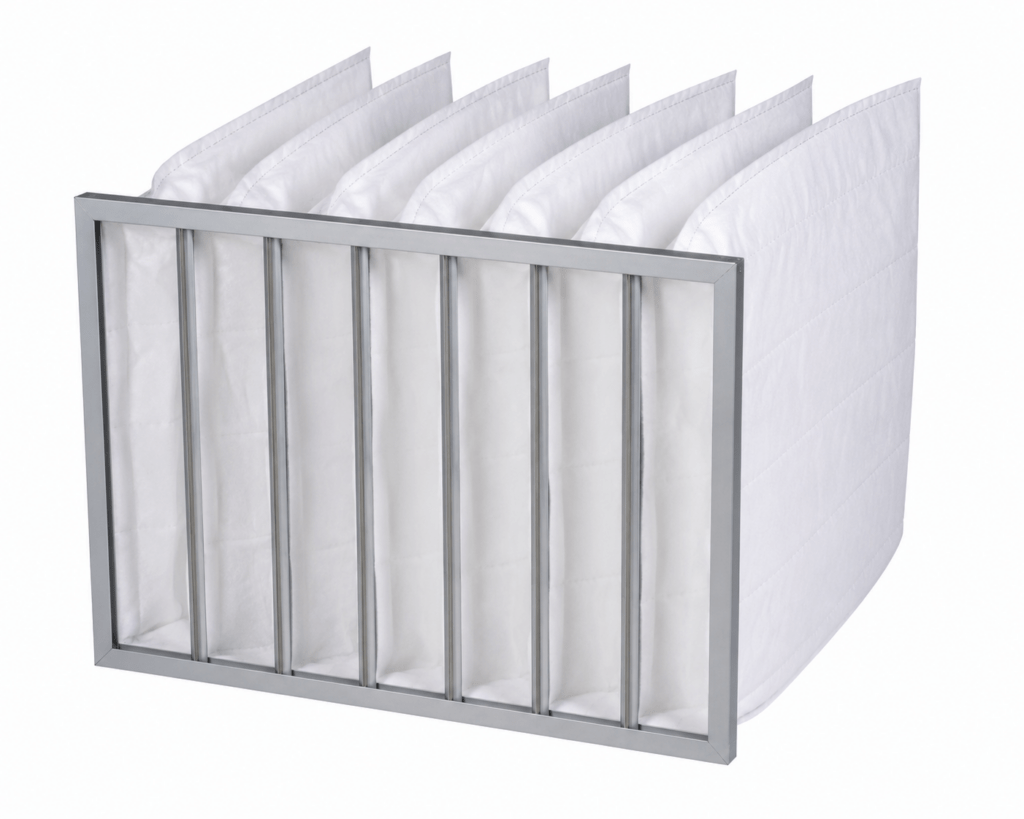
A bag filter is a fabric filtration system that removes particulate matter (dust, fumes, fine particles) from gas or air streams before releasing them into the atmosphere.
The filter uses woven or needle-felt fabric bags as the filtration medium. Dust-laden gas passes through these bags; particles get trapped on the fabric surface; clean gas exits.
Bag filter = baghouse filter. Same equipment, different names. “Bag filter” is commonly used for smaller, standalone units. “Baghouse filter” or “bag house filter” refers to large industrial enclosures that house multiple bag assemblies — common in cement, steel, and power sectors.
There are two primary categories:
- Air/dust bag filters — for industrial gas streams, flue gas, process exhaust, and ambient dust collection
- Liquid bag filters — for filtering solids from liquid streams in chemical, food, and water treatment processes
This guide focuses on air and dust bag filters, which are the core product for industrial emission control.
How Does a Bag Filter Work?
The operating principle is straightforward. Here is the sequence:
Step 1 — Inlet: Dust-laden gas enters the baghouse through an inlet duct. Depending on the design, this can be from the top or bottom of the unit.
Step 2 — Filtration: Gas passes through fabric bags. Dust particles are too large to pass through the fabric and collect on the outer or inner surface (depending on design). The fabric acts as a depth filter — efficiency increases as the dust cake builds up.
Step 3 — Cleaning: Over time, the dust cake reduces airflow. A cleaning mechanism dislodges the accumulated dust. Three main cleaning methods are used: pulse jet (compressed air blast), reverse air (reverse airflow), and mechanical shaking.
Step 4 — Dust collection: Dislodged dust falls into a hopper at the bottom of the unit.
Step 5 — Clean air outlet: Cleaned gas — with particulate concentrations typically below 10 mg/Nm³ — exits through the outlet duct.
The cycle repeats continuously during operation. Most modern bag filters clean online (without stopping airflow), which keeps pressure drop stable and production uninterrupted.
Types of Bag Filters
Pulse Jet Bag Filter
The most widely used design globally. Cleaning happens through short bursts of compressed air fired in the opposite direction of gas flow. This dislodges the dust cake without stopping operation (online cleaning).
Best for: Continuous industrial processes, fine and dry dust, high gas volumes, cement, steel, pharma, food industries.
Efficiency: 99.9%+ for particles above 1 micron.
Reverse Air Bag Filter
Gas flow is reversed through the bags to collapse them slightly and dislodge dust. Cleaning is gentle — no mechanical shock to fabric. Bags last longer but the unit size is larger.
Best for: Large volume applications, fragile fabrics, sticky or hygroscopic dust, applications where fabric life is a priority.
Shaker Bag Filter
Bags are mechanically shaken to dislodge dust. An older technology, still used in smaller installations.
Best for: Low-to-medium gas volumes, batch processes, smaller industrial setups. Offline cleaning means airflow must stop during cleaning cycles.
Top Entry Pulse Jet
Gas enters from the top of the unit. Dust falls directly into the hopper without re-entering the clean air zone. Simpler layout, lower risk of re-entrainment.
Bottom Entry Pulse Jet
Gas enters from the bottom. A baffle plate prevents direct impact on bags. More common in retrofitted or space-constrained installations.
Modular Pulse Jet Bag Filter
Built in bolt-on modules. You can start with one module and expand capacity later without major civil or structural changes.
Best for: Plants with phased expansion plans, fluctuating production volumes.
Cylindrical Bag Filter
Circular cross-section design. More compact footprint compared to rectangular baghouses of the same capacity.
Best for: Space-constrained installations, smaller dust loads, secondary dust collection points.
Long Bag Pulse Jet Bag Filter
Uses bags 6–10 metres long instead of the standard 2–3 metres. More filtration area per unit footprint. Useful where floor space is limited but height is available.
Best for: High-capacity applications with vertical space constraints.
Bag Filter vs Bag House Filter — What Is the Difference?
Competitors rarely explain this clearly. Here is the plain answer.
They are the same technology. The terms are used interchangeably in industry.
The practical distinction is scale:
| Term | Typical Scale | Common Setting |
|---|---|---|
| Bag filter | Smaller, standalone unit | Pharma, food, secondary dust points |
| Baghouse / bag house filter | Large enclosure with multiple bag modules | Cement kilns, steel plants, power plants |
A cement kiln exhaust system will have a baghouse with thousands of bags. A pharmaceutical FBD (fluid bed dryer) will have a compact bag filter with 20–50 bags.
Same operating principle. Different scale, different housing design.
Filter Bag Materials — Which Fabric to Choose?
The fabric choice determines performance, temperature resistance, and bag life. Here is a reference table:
| Material | Max. Temperature | Best For |
|---|---|---|
| Polyester (PE) | 130°C | General industrial dust, ambient air |
| Polypropylene (PP) | 80°C | Chemical, food, pharmaceutical applications |
| Fiberglass | 260°C | Cement kilns, steel plants, high-temperature exhaust |
| PTFE (Teflon) | 260°C | Corrosive gases, chemical plants, acid mist |
| Aramid (Nomex) | 200°C | Hot gas filtration, asphalt, carbon black |
| Acrylic (Dralon) | 130°C | Wet, humid, or slightly acidic gas streams |
PTFE membrane laminate is available on most fabrics. It gives surface filtration instead of depth filtration — easier cleaning, higher efficiency, longer bag life. Worth specifying for fine dust (sub-micron particles) or sticky dust.
Industrial Applications of Bag Filters
Cement Industry
Cement manufacturing produces dust at every stage — raw mills, kiln inlets and outlets, clinker coolers, coal mills, cement mills, packing plants. Bag filters handle all these points. Fiberglass bags are standard for high-temperature kiln exhaust (up to 250°C). Polyester works for ambient temperature points like packing.
Steel and Metal Industry
Electric arc furnace (EAF) fumes contain fine metallic particles and heavy metals. Blast furnace gas has high dust loading. Both require high-efficiency baghouses. PTFE membrane bags are common here because the dust is fine and the emission limits are strict.
Pharmaceutical Industry
Spray dryers, fluid bed dryers (FBD), granulation lines, and tablet coating units all generate fine product-containing dust. Bag filters here serve two purposes: emission control and product recovery. Polypropylene bags are standard because they are easy to clean and FDA-compliant materials are available.
Chemical Industry
Reactor vents, dryer exhausts, and pneumatic conveying systems generate chemically active dust and gas. Material compatibility with the process chemical is critical. PTFE bags or PTFE-laminated polyester are common.
Food and Spice Industry
Grinding, milling, blending, and packaging generate fine dust (flour, spice powder, sugar). Contamination risk is high — bag materials must be food-grade. Polypropylene is the standard choice. Explosion-proof designs are required for combustible dust.
Power Plants
Flue gas from coal-fired boilers carries fly ash. Large baghouses with fiberglass or PTFE bags handle the volume and temperature. These installations can have 10,000+ bags in a single baghouse.
Mineral and Mining
Crushing, screening, conveying, and transfer points generate coarse to fine mineral dust. Polyester bags work for most applications. High-abrasion fabrics are available for applications with coarse, sharp particles.
How to Choose the Right Bag Filter
Most buyers focus only on price. The parameters that determine whether a bag filter actually performs:
1. Gas volume (airflow) Measured in m³/hr or CFM. Size the bag filter for peak gas volume, not average. Undersized units have high pressure drop and short bag life.
2. Dust type and concentration Fine dust (below 5 microns) needs PTFE membrane bags and lower air-to-cloth ratios. Coarse dust is easier. Sticky or hygroscopic dust needs anti-stick coatings and robust cleaning systems. Inlet concentration above 20 g/Nm³ needs pre-separation (cyclone before bag filter).
3. Operating temperature Choose bag material with a temperature limit at least 20–30°C above your peak process temperature. Temperature spikes during upsets destroy wrong-material bags immediately.
4. Cleaning mechanism Pulse jet is the standard for continuous operations. Reverse air or shaker suits applications where offline cleaning is acceptable and fabric life is priority.
5. Emission standard CPCB (India) standards vary by industry — from 50 mg/Nm³ for general industry to 10 mg/Nm³ or below for regulated sectors. Design the bag filter to achieve outlet below the limit with a safety margin.
6. Space and layout Modular or cylindrical designs for constrained spaces. Long bag designs where height is available. Standard rectangular baghouses where footprint is not a constraint.
7. Maintenance access Top-access bag replacement vs bottom-access. Ease of bag change directly affects maintenance time and downtime costs.
Bag Filter Technical Specifications — Reference Table
| Parameter | Typical Range |
|---|---|
| Filtration efficiency | 99.9% for particles > 1 micron |
| Operating temperature | Up to 260°C (fabric-dependent) |
| Inlet dust concentration | Up to 50 g/Nm³ (higher requires pre-separator) |
| Outlet emission | 1–10 mg/Nm³ |
| Pressure drop | 100–250 Pa (stable with good cleaning) |
| Air-to-cloth ratio | 1–3 m³/m²/min (application-dependent) |
| Bag diameter | 100–160 mm standard |
| Bag length | 2–10 m depending on design |
| Cleaning compressed air pressure | 5–7 bar (pulse jet) |
Why Choose Fiilters.com as Your Bag Filter Manufacturer?
Fiilters.com designs and manufactures bag filters and baghouse systems for industrial applications across India. Key capabilities:
- Custom engineering — every unit designed to your process parameters, not off-the-shelf sizing
- Full range of fabric choices — polyester, polypropylene, fiberglass, PTFE, aramid, PTFE membrane laminates
- All cleaning types — pulse jet, reverse air, shaker, top and bottom entry configurations
- Export capability — units supplied to clients across South Asia and beyond
- After-sales support — replacement bags, spare parts, and field service
Get a quote specific to your process: gas volume, temperature, dust type, and emission requirement.
Frequently Asked Questions
What is a bag filter?
A bag filter is an air pollution control device that uses fabric filter bags to remove dust and fine particles from industrial gas streams. It is also called a fabric filter, baghouse, or bag house filter. Efficiency typically exceeds 99.9% for particles above 1 micron.
How long do filter bags last?
Bag life depends on fabric choice, operating temperature, dust type, and cleaning system condition. Polyester bags in normal industrial conditions last 2–4 years. Fiberglass and PTFE bags in high-temperature applications typically last 18–36 months. Bags fail early when operating temperature exceeds the fabric limit, cleaning system pressure is too high, or inlet concentration is far above design.
What fabric is best for high-temperature applications?
Fiberglass handles up to 260°C and is the standard for cement and steel applications. PTFE (Teflon) also handles 260°C and adds chemical resistance. Aramid (Nomex) is suitable up to 200°C. For temperatures above 260°C, ceramic fiber bags are available — but these are specialized and expensive.
What is the difference between bag filter and baghouse filter?
They are the same technology. “Baghouse” or “bag house filter” is the term used for large industrial enclosures with multiple bag assemblies. “Bag filter” is more common for smaller, standalone units. The operating principle — fabric filtration with periodic cleaning — is identical.
Get a Quote
Most bag filter problems start at the buying stage — wrong fabric, undersized airflow, cleaning system that can’t handle the dust load.
We don’t send catalogue options. Tell us your process — gas volume, temperature, dust type, industry, emission target — and we engineer the unit to match.
Response within 24 hours. No generic quotes.