
HEPA 13 Filter (H13): Efficiency, Uses & Manufacturer Guide
Introduction
Indoor air can carry dust, bacteria, PM2.5, pollen, and in some cases virus-sized particles small enough to pass through a standard filter. Indoor air quality can be just as poor as outdoor air, depending on ventilation, and Delhi’s outdoor air quality is a well-known concern.
A HEPA filter is designed to capture airborne particles with very high efficiency.
Fiilters manufactures both HEPA 13 (H13) and HEPA H14 filters in Delhi, under an ISO 9001-certified quality management system, for hospitals, pharma cleanrooms, IT offices, and home air purifiers across India.
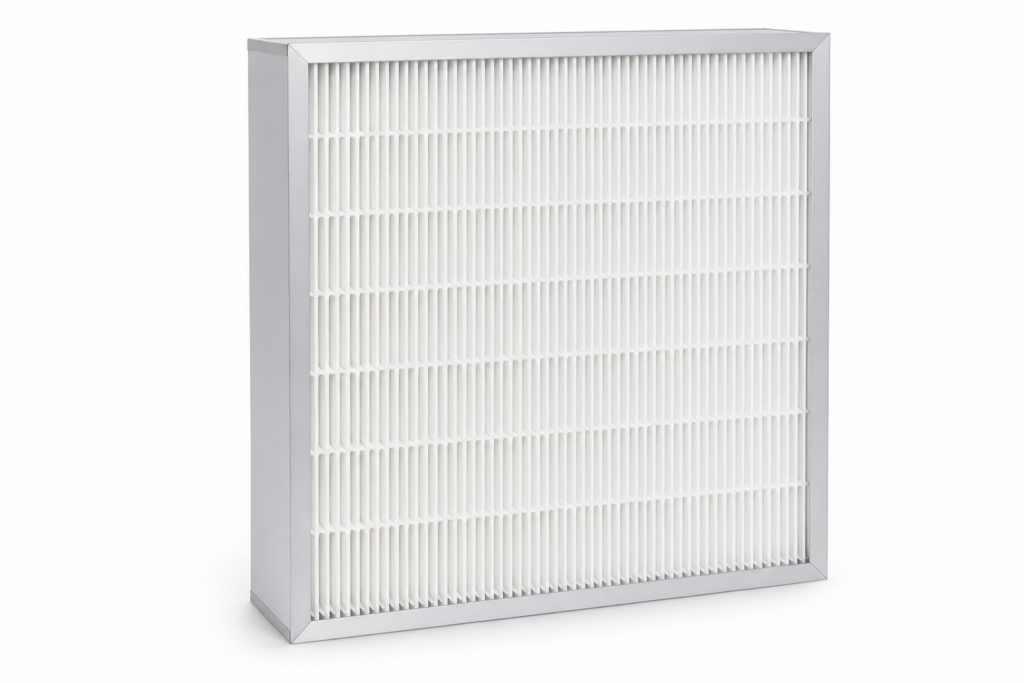
What is H13?
HEPA 13 filters ≥99.95% of particles at the Most Penetrating Particle Size (MPPS), the particle size that’s hardest for a filter to catch, typically around 0.3 microns. For every 10,000 particles that enter, at most 5 pass through.
A HEPA filter works through 4 mechanisms:
- Impaction: larger particles can’t follow the airflow curve and hit a fibre directly.
- Interception: mid-size particles pass close enough to a fibre to get caught.
- Diffusion: sub-0.1 micron particles move randomly (Brownian motion), which raises their odds of hitting a fibre.
- Sieving: very large particles can’t fit through the gaps between fibres.
At H13 efficiency, the filter handles PM2.5, most airborne bacteria, pollen, mold spores, and many aerosolized virus particles.
What is H14?
HEPA H14 filters ≥99.995% of particles at MPPS, 10x better than H13. For every 100,000 particles entering, at most 5 pass through.
That gap matters in surgical operating theatres and pharma cleanrooms, where airborne contamination can cause a failed batch or a post-op infection. H14 is the grade commonly specified for GMP audits, ISO Class 5 cleanrooms, and NABH-accredited hospital OTs, depending on project requirements.

H13 vs H14: key difference
The core difference is filtration efficiency at MPPS: H13 stops ≥99.95% of particles, H14 stops ≥99.995%. That’s a 10x drop in particles getting through.
Beyond the number, the two grades differ in pressure drop, typical use case, and cost. H13 suits general commercial and healthcare spaces. H14 suits regulated, high-contamination-risk environments. The sections below cover each difference in detail.

H13 vs H14 efficiency
| Metric | H13 | H14 |
|---|---|---|
| Filtration at MPPS (~0.3 microns) | ≥ 99.95% | ≥ 99.995% |
| Leakage allowance | ≤ 0.05% | ≤ 0.005% |
| Particles through per 100,000 | ~50 | ~5 |
H14 cuts the particles that get through by a factor of 10, compared to H13.
EN 1822 testing
EN 1822, published by the European Committee for Standardization, is the international HEPA standard. It classifies filters from H10 to U17 and is the benchmark Indian pharma, hospital, and cleanroom procurement teams use.
H13 and H14 filters are tested and classified according to the applicable requirements of EN 1822. The testing method and documentation depend on the filter specification and the test requirements agreed with the customer.
Each filter ships with a test certificate. Talk to our team about the specific test documentation available for your order.
Pressure drop
Pressure drop is the resistance a filter puts on airflow. It depends on filter media, media area, pleat design, face velocity, filter dimensions, and overall construction, not on the efficiency grade alone.
H14 designs may have higher pressure drop than comparable H13 designs, but the actual value is product-specific. Media is machine-pleated to increase surface area inside a fixed frame; more surface area generally means a lower pressure drop at a given efficiency, which is why pleat design matters as much as the media grade.
H13 applications
- Hospital wards and OPDs
- Corporate office HVAC in multi-floor buildings
- Classrooms (30 to 50 occupants)
- Home air purifiers, 200 to 500 CADR units
- Commercial kitchens (grease plus PM2.5)
- IT server rooms
H13 is the right choice when you need clean air at scale without the pressure drop or cost of H14.
H14 applications
- Pharmaceutical cleanrooms, ISO Class 5 and above
- ICUs and operating theatres
- Semiconductor fabrication
- Biotech and research labs, BSL-2 and BSL-3
- Defense and aerospace assembly lines
H14 is for environments where contamination has a direct cost: product failures, infection risk, or regulatory non-compliance.
H13 vs H14 comparison table
| Parameter | H13 | H14 |
|---|---|---|
| Filtration efficiency (MPPS) | ≥ 99.95% | ≥ 99.995% |
| Leakage allowance | ≤ 0.05% | ≤ 0.005% |
| Test method | Per EN 1822, as specified | Per EN 1822, as specified |
| Pressure drop | Lower | Higher |
| Airflow resistance | Moderate | High |
| Cost | Moderate | Higher |
| Replacement cycle | Depends on usage and site conditions | Depends on usage and site conditions |
| Best environment | Offices, hospitals, homes | Pharma, OT, cleanrooms |
| Compliance requirement | General healthcare, LEED | GMP, ISO Class 5 to 7, NABH |
| Custom sizes | Yes | Yes |
How to choose H13 or H14
Setting up a commercial HVAC system or a hospital ward: H13 is generally the right grade.
Working under GMP, ISO cleanroom standards, or surgical protocol: H14 may be specified, depending on the room classification, system design, and applicable project requirements.
Both grades are manufactured at our Delhi facility. If you’re unsure, share your AHU specs or room use case and we’ll confirm the grade.
How H13/H14 filters are manufactured
Media sourcing. High-efficiency filter media is selected according to the required filter performance and application. Incoming media is checked for consistency and suitability before production. Finished filters are tested and classified per EN 1822.
Pleating. Media is machine-pleated to raise surface area inside a fixed frame size, which lowers pressure drop at a given efficiency.
Sealing. Pleated packs are sealed into aluminium, galvanized steel, or MDF frames with hot-melt or polyurethane sealant. Pharma units require PU sealant for chemical compatibility.
Testing. Filters are tested and classified according to the applicable requirements of EN 1822, with test method and documentation agreed per order.
Documentation. Every filter ships with a test certificate.
Available filter configurations
Both H13 and H14 are available in standard catalogue sizes and custom configurations:
- Frame materials: aluminium, galvanized steel, or MDF
- Sealant: hot-melt or polyurethane, chosen by application
- Custom frame dimensions, depths, and pleat counts to drawing
- OEM configurations for air purifier manufacturers, HVAC contractors, and hospital engineering teams
Custom orders take 7 to 10 working days.
How to order the right HEPA filter
Share your requirement with our team in whichever way is easiest:
- AHU or system specification, if you have one
- Room type and use case (ward, OT, office, cleanroom, home purifier)
- Required frame size, depth, and material, or your existing filter’s dimensions for a like-for-like match
We’ll confirm the grade, size, and lead time before you order. For bulk or OEM orders, pricing is negotiated directly with our production team.
Quality and testing
Fiilters operates under an ISO 9001-certified quality management system. Filter production follows EN 1822 methodology, and each filter ships with a test certificate.
Our team can review your AHU specifications and recommend the right filter grade, frame type, and replacement schedule based on your site conditions.
Frequently Asked Questions
What’s the difference between H13 and H14?
H13 filters ≥99.95% of particles at MPPS; H14 filters ≥99.995%. Both grades are tested and classified per EN 1822, with documentation agreed per order. H14 fits pharma cleanrooms, OTs, and ISO Class 5 to 7 environments; H13 covers hospitals, offices, and homes.
Which HEPA filter is best for hospitals in India?
General wards and OPDs: H13 is generally sufficient and cost-effective. OTs and ICUs: H13 or H14 may be specified depending on the room classification, system design, and applicable project requirements.
Can H13 remove PM2.5?
Yes. PM2.5 particles are 2.5 microns, well within H13’s filtration range. Since H13 removes 99.95% of particles at the harder 0.3 micron size, PM2.5 is captured at an even higher rate.
Do you manufacture custom size HEPA filters?
Yes, in any frame size, depth, or material, for both grades. Standard lead time for custom orders is 7 to 10 working days.
What is EN 1822?
The European standard that classifies and tests high-efficiency air filters (HEPA and ULPA), covering test methods, efficiency classes (H10 to U17), and documentation. It’s the standard pharma auditors, hospital accreditation bodies, and cleanroom consultants use in India.
How often should HEPA filters be replaced?
Replacement depends on pressure drop, airflow performance, operating hours, particle loading, and site-specific maintenance requirements. Share your usage conditions with our team for a recommended schedule.
Conclusion
HEPA 13 filter and H14 filters solve different problems. HEPA 13 filter gives you clean air for everyday commercial and healthcare environments. H14 gives you the filtration precision that regulated industries require.
Both are manufactured at our Delhi facility — pleated, sealed, tested, and documented to EN 1822 standards.
If you know what you need, contact us for a quote. If you’re unsure which grade fits your application, share your AHU specifications or room use case and our team will recommend the right filter.
- WhatsApp: 96255 55709
- Email: bafcustomercare@gmail.com
- Website: fiilters.com
- Factory: 197/3, Gali No. 3, Padam Nagar, Sarai Rohilla, Delhi, 110007, India
Fiilters is an ISO-certified air filter manufacturer based in Delhi, India. We manufacture HEPA 13 filter, HEPA H14, bag filters, pre-filters, carbon filters, and custom filtration solutions for industrial, pharmaceutical, and commercial applications.