
Carbon Filter Manufacturer in India | Activated Carbon Filters
Industrial water and air systems collect contaminants that standard filters can’t remove. Chlorine, organic compounds, dissolved chemicals, and unpleasant odours often pass through sediment filtration without resistance. Activated carbon technology helps eliminate these impurities and improves overall water and air quality.
We are a manufacturer of industrial filtration solutions for commercial, industrial, and water treatment applications across India. This guide explains how a carbon filter works, the different types available, selection criteria, and the industries that rely on this technology.
What Is a Carbon Filter?
A carbon filter uses activated carbon as the filter media. Activated carbon is carbon that has been processed to create millions of tiny pores across its surface. These pores trap contaminants through a process called adsorption — the contaminant molecules stick to the carbon surface and stay there.
The result is water or air that comes out cleaner, with chlorine, volatile organic compounds (VOCs), pesticides, industrial chemicals, and odour-causing substances removed.
Carbon filters don’t just trap particles the way a sediment filter does. They chemically bind contaminants to the media. That’s what makes them necessary in applications where sediment filtration alone isn’t enough.
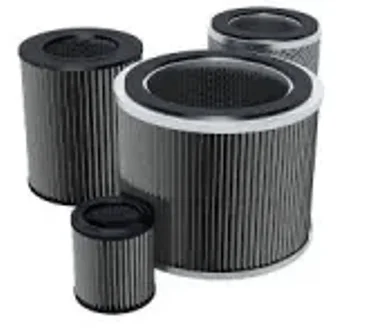
Activated Carbon Filter vs Carbon Filter
People use both terms for the same thing. Every carbon filter uses activated carbon — plain carbon without activation has too little surface area to be useful as a filter. So “carbon filter” and “activated carbon filter” refer to the same product.
The difference you’ll see on spec sheets is in the form of activated carbon used:
Granular Activated Carbon (GAC) — Loose carbon granules packed into a housing. Water or air passes through the bed. High contact time, good for large flow systems.
Carbon Block Filter — Activated carbon compressed into a solid block. Finer filtration, more consistent performance, slower flow rate. Standard in water purifiers and drinking water systems.
Activated Carbon Cartridge — A cartridge housing pre-filled with GAC or carbon block. Drop-in replacement, easy maintenance. Used in residential and light commercial systems.
Powdered Activated Carbon (PAC) — Fine carbon powder added directly to water during treatment, then removed by settling or filtration. Used in municipal water treatment plants.
How a Carbon Filter Works
Water or air enters the carbon filter housing. It passes through the activated carbon bed or block. Contaminant molecules — chlorine, THMs, VOCs, hydrogen sulphide, organic compounds — attach to the carbon surface through adsorption. Clean fluid exits the other side.
The carbon has a finite number of adsorption sites. Once those sites are full, the filter stops working. That’s why carbon filters have a fixed service life — usually measured in litres processed or months of use — after which the media needs replacement.
Temperature and flow rate both affect performance. Slower flow gives contaminants more contact time with the carbon, which improves removal efficiency. High-temperature applications need carbon media rated for the process temperature.
Why Carbon Filters Are Important in India
India’s water supply carries chlorine added during municipal treatment, along with agricultural runoff, industrial discharge, and naturally occurring dissolved organics. Standard sediment filtration removes suspended particles. It doesn’t remove chlorine or dissolved chemicals.
For industrial processes in pharmaceuticals, food and beverage, and electronics manufacturing, chlorine in process water damages membranes, affects product quality, and corrodes equipment. Activated carbon water filters are the standard solution for dechlorination before these processes.
Air quality in Indian industrial environments — paint booths, chemical plants, printing facilities — contains VOCs and chemical vapours that require activated carbon air filters for worker safety and regulatory compliance.
Carbon filters address the contamination that sediment filters miss.
Types of Carbon Filters We Manufacture
Activated Carbon Water Filter
Used across drinking water, industrial process water, and water treatment plants. Removes chlorine, chloramines, THMs, pesticides, herbicides, and organic compounds. Available in GAC housing and carbon block cartridge formats.
Industrial Carbon Filter
Heavy-duty housings for high-flow industrial applications. Steel or FRP housing with replaceable activated carbon media. Used in pharmaceutical manufacturing, food processing, and chemical plants where large volumes of water need dechlorination before RO or UV treatment.
Carbon Air Filter
Removes VOCs, chemical fumes, odours, and gases from air streams. Used in paint spray booths, chemical storage rooms, printing facilities, and HVAC systems where air quality standards apply. Media options include impregnated carbon for specific gas removal — hydrogen sulphide, ammonia, acid gases.
HVAC Carbon Filter
Panel or pocket format carbon filter for air handling units. Removes odours and low-level chemical contamination from recirculated air. Used in hospitals, hotels, commercial buildings, and food processing facilities.
Carbon Block Filter Cartridge
Compressed carbon block in standard 10-inch or 20-inch cartridge format. Precise micron rating with carbon filtration in one stage. Standard in water purifiers, under-sink systems, and point-of-use water treatment.
Custom Carbon Filter
Non-standard housing sizes, specific carbon media types (coconut shell carbon, coal-based carbon, wood-based carbon), and application-specific configurations for OEM and industrial buyers.
How to Choose the Right Carbon Filter
What are you removing?
Chlorine and taste/odour — standard GAC or carbon block. VOCs and industrial chemicals — higher-grade activated carbon with longer contact time. Specific gases in air — impregnated carbon selected for the target gas. Get the contaminant list right before specifying the carbon type.
Flow rate.
GAC filters handle higher flow rates than carbon block. If your system needs 5,000 LPH, a carbon block cartridge won’t keep up. Size the housing to your actual flow or you’ll see pressure drop and reduced contact time.
Contact time.
Activated carbon needs time to adsorb contaminants. Empty bed contact time (EBCT) of 5–10 minutes is standard for municipal water dechlorination. Faster flow means less contact time and lower removal efficiency.
Carbon media type.
Coconut shell activated carbon has the highest micropore density — best for chlorine, VOCs, and taste/odour removal. Coal-based carbon works well for larger organic molecules. Wood-based carbon is used in specific decolourisation applications.
Service life.
Calculate total volume processed or total contaminant load rather than just time elapsed. A carbon filter in a high-chlorine supply exhausts faster than the same filter on low-chlorine water at the same flow rate.
Housing material.
Food-grade PP for drinking water systems. FRP or coated steel for large industrial systems. Stainless steel for pharmaceutical and high-pressure applications.
Carbon Filter vs Other Filter Types
| Feature | Carbon Filter | Sediment Filter | RO Membrane |
|---|---|---|---|
| Removes particles | Partial | Yes | Yes |
| Removes chlorine | Yes | No | Partial |
| Removes VOCs | Yes | No | Partial |
| Removes dissolved salts | No | No | Yes |
| Removes odour | Yes | No | Partial |
| Typical position in system | After sediment, before RO | First stage | Final stage |
| Replacement frequency | 6–12 months typically | 1–3 months | 2–5 years |
In most multi-stage water treatment systems, the order is: sediment pre filter → activated carbon filter → RO membrane → UV. The carbon filter protects the RO membrane from chlorine, which degrades membrane material over time.
Industries We Supply Carbon Filters To
Pharmaceuticals.
API manufacturing and sterile water production require dechlorinated, low-TOC water. Activated carbon filters are mandatory before RO and EDI systems in GMP-compliant facilities. We supply to pharmaceutical plants across Gujarat, Hyderabad, and Mumbai.
Food and Beverage.
Breweries, bottling plants, and dairy facilities use carbon filters to remove chlorine and organics from process water. Chlorine at even low concentrations affects product taste and can disrupt fermentation.
HVAC and Commercial Buildings.
Carbon panel filters in AHU systems remove odours and VOCs from recirculated air. Hotels, hospitals, and office buildings use these to maintain indoor air quality standards.
Paint and Coatings.
Spray booths generate high concentrations of solvent vapours. Activated carbon air filters in exhaust systems capture VOCs before discharge, which is a requirement under environmental regulations.
Electronics Manufacturing.
Semiconductor and PCB manufacturing use ultrapure water. Carbon filtration is a standard stage before the ion exchange and polishing steps that produce ultrapure water.
Textile.
Dyeing and finishing use large volumes of process water. Carbon filtration removes colour, residual chemicals, and organics from effluent before treatment or discharge.
Municipal Water Treatment.
PAC dosing and GAC filter beds are standard in municipal water plants for taste, odour, and micropollutant control. We supply GAC media and filter housings to municipal projects across India.
Pre Filter + Carbon Filter: The Right Combination
A carbon filter performs best when the incoming water or air is free from excessive sediment and suspended particles. Heavy contamination can clog the media bed, reduce the available adsorption surface area, and significantly shorten service life.
The recommended setup is simple: a sediment pre filter as the first stage, followed by activated carbon filtration.
For water treatment systems, a 5–25 micron pre filter helps extend media life by 2–4 times under typical Indian hard water conditions. In air filtration applications, a particulate pre filter prevents dust accumulation and maintains filtration efficiency over a longer period.
We manufacture both pre filters and activated carbon filtration systems, ensuring matched housing sizes, compatible flow rates, custom configurations, and reliable technical support from a single source.
Maintenance: What to Track
Water carbon filters.
Monitor total volume processed against the rated capacity. For a 10-inch carbon block cartridge rated at 6,000 litres, track actual throughput. In high-chlorine municipal supply, replace at 80% of rated capacity rather than waiting for full exhaustion.
GAC beds.
Backwash periodically to prevent channelling — where water finds a path of least resistance through the bed rather than distributing evenly. Backwash frequency depends on incoming water turbidity; monthly backwash is typical in Indian municipal supply.
Air carbon filters.
No direct measurement equivalent to water volume exists for air filters. Replace on a scheduled basis — typically every 6 months in moderate VOC environments, every 3 months in high-concentration applications. Breakthrough testing with detection tubes gives a more precise replacement point.
Signs the carbon is exhausted.
For water: chlorine taste returns, odour reappears, or downstream RO membrane shows accelerated degradation. For air: odour or chemical smell passes through the filter into the treated space.
About Us
Fiilters.com manufactures carbon filters, activated carbon filters, and activated carbon water filters for industrial and commercial buyers across India. We are a direct manufacturer — not a trader or distributor.
- 10+ years manufacturing industrial filters
- Custom carbon filter sizes and media specifications
- OEM and white-label supply for system integrators
- Industries served: Pharmaceuticals, food and beverage, HVAC, water treatment, textiles, electronics, paint and coatings
- Carbon media options: Coconut shell, coal-based, wood-based, impregnated carbon
- Housing materials: PP, FRP, SS, food-grade options
- Pan India delivery including tier-3 and tier-5 cities
Carbon Filter Supplier Locations Across India
Carbon Filter Manufacturer in Delhi.
We supply activated carbon water filters, HVAC carbon filters, and industrial carbon filters to manufacturing units, hospitals, and commercial facilities across Delhi NCR.
Carbon Filter Supplier in Mumbai.
Pharmaceutical plants, food processing units, and water treatment facilities in Mumbai and Navi Mumbai source activated carbon filters directly from our manufacturing unit.
Carbon Filter Manufacturer in Ahmedabad.
Gujarat’s pharma and chemical manufacturing base is a major market. We supply industrial carbon filters and custom GAC housings to plants across Ahmedabad, Vadodara, and Surat.
Carbon Filter Supplier in Pune.
Automotive, electronics, and HVAC projects in Pune source carbon filters and filter housings from us regularly.
Carbon Filter Manufacturer in Hyderabad.
API manufacturers, bulk drug producers, and IT facility HVAC systems in Hyderabad use our activated carbon filters in their water and air treatment systems.
We deliver across all major Indian industrial zones. Contact us for supply to other locations.
Frequently Asked Questions
What is a carbon filter?
This filtration system uses activated carbon media to remove chlorine, VOCs, dissolved organic compounds, and odour from water or air. The media adsorbs contaminants onto its surface, making it a standard solution for dechlorination and chemical removal in water treatment and air purification applications.
What is an activated carbon filter?
It uses activated carbon that has been processed to create a vast internal surface area with millions of microscopic pores. This activation process provides the adsorption capacity required for effective contaminant removal. In industrial applications, both terms generally refer to the same technology.
What is an activated carbon water filter?
This type of filtration system removes dissolved contaminants from water, including chlorine, chloramines, THMs, pesticides, herbicides, and organic compounds that affect taste and odour. It does not remove dissolved salts or heavy metals, which typically require RO or ion exchange treatment. In multi-stage systems, it is installed between the sediment stage and the RO membrane.
How does it work?
Water or air passes through activated carbon media, where contaminant molecules attach to the surface through adsorption. The media contains a limited number of adsorption sites, so replacement is required once capacity is exhausted. Slower flow rates generally improve removal efficiency by increasing contact time.
How long does it last?
A 10-inch carbon block cartridge typically treats 6,000–10,000 litres before replacement, depending on water quality. GAC beds in industrial systems generally last 12–24 months with periodic backwashing. High chlorine concentrations and heavy organic loads reduce service life, so performance monitoring is recommended.
What’s the difference between GAC and carbon block filters?
GAC (Granular Activated Carbon) uses loose carbon granules and supports higher flow rates. Carbon block media is compressed into a solid structure, providing finer and more consistent filtration at lower flow rates. Carbon block is common in drinking water systems, while GAC is preferred for large-scale industrial dechlorination.
Do you supply custom solutions?
Yes. We manufacture custom housings, media configurations, and micron ratings according to application requirements. OEM and white-label supply options are available. Share your specifications and we will confirm feasibility and lead time.
Conclusion
A carbon filter removes contaminants that sediment filtration cannot handle, including chlorine, dissolved organic compounds, VOCs, and odour-causing substances. In Indian industrial and municipal water systems, it plays an important role in maintaining water quality and protecting downstream equipment.
Selecting the correct media, sizing the system according to flow rate, and replacing the filtration media before exhaustion are the key factors that determine long-term performance and efficiency.
Contact us for filtration system specifications, bulk pricing, OEM supply, and custom manufacturing solutions. Pan India delivery available.