
Best HEPA Filter Manufacturer in Delhi | ISO Certified
By Neeraj Goel | Fiilters.com Technical Team | 10+ Years Manufacturing Experience
Introduction
Delhi’s air is a problem you can’t ignore.
AQI crosses 300 in winter. PM2.5 sits at 60 to 90 µg/m³ year-round — nearly 12 to 18x the WHO safe limit of 5 µg/m³. And inside homes, hospitals, and offices, the air is often worse than outside because buildings trap particulates without adequate filtration.
A HEPA filter removes these particles. Not reduces. Removes — 99.95% or more, depending on the grade.
At Fiilters, we are a leading HEPA Filter Manufacturer in Delhi — H10 to H14 grade, ISO 9001 certified facility, quality tested before dispatch — used by hospitals, pharmaceutical cleanrooms, corporate offices, and home air purifiers across India.
Looking for a reliable HEPA Filter Manufacturer in Delhi? This guide covers everything: how HEPA works, which grade you need, how to verify a genuine manufacturer, and how to maintain your filter for maximum life.
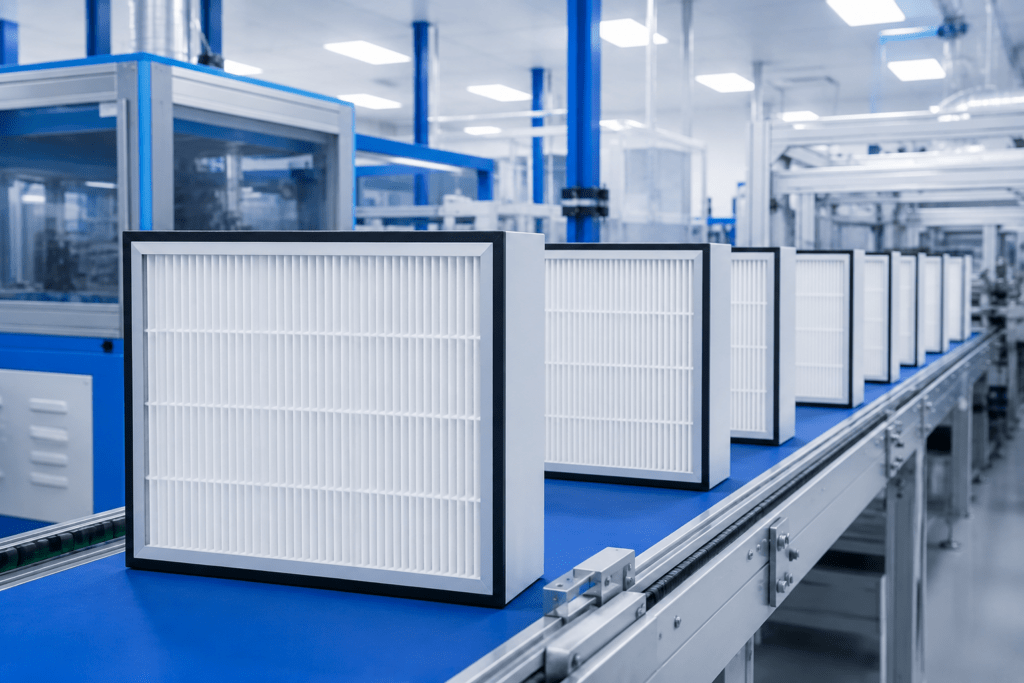
What is a HEPA filter?
HEPA stands for High-Efficiency Particulate Air.
A HEPA filter is a dense, pleated mat of fine glass fibres. Air passes through it. Most particles do not.
How it works — 3 mechanisms
1. Impaction
Larger particles above 1 micron can’t follow airflow curves around fibres. They travel straight and hit a fibre directly. They stick.
2. Interception
Mid-size particles follow the airflow but pass close enough to a fibre to get caught on contact. No direct collision needed.
3. Diffusion
Tiny particles below 0.1 micron move randomly due to Brownian motion. This random path increases the chance of hitting and sticking to a fibre.
At 0.3 microns, particles are the hardest to capture — small enough to avoid impaction, large enough to avoid diffusion. This is called the Most Penetrating Particle Size (MPPS). All HEPA grades are rated at this worst-case size.
Particle size reference
| Particle | Size |
|---|---|
| PM2.5 | 2.5 microns |
| Bacteria | 0.5 to 5 microns |
| Pollen | 10 to 100 microns |
| Tobacco smoke | 0.01 to 1 micron |
| Mould spores | 1 to 30 microns |
| Virus (airborne) | 0.02 to 0.3 microns |
H13 and H14 HEPA filters capture all of these — including virus-range particles — because the 99.95% and 99.995% ratings apply at the hardest-to-capture size of 0.3 microns.
HEPA filter grades explained
HEPA filters are classified under EN 1822 — the European standard used by Indian manufacturers and accepted in international procurement.
| Grade | Overall Efficiency | Local Efficiency | Best Application |
|---|---|---|---|
| H10 | 85% | 65% | Pre-filtration, general ventilation |
| H11 | 95% | 75% | Commercial HVAC, offices |
| H12 | 99.5% | 97.5% | Cleanrooms, labs |
| H13 | 99.95% | 99.75% | Homes, hospitals, high-pollution areas |
| H14 | 99.995% | 99.975% | Operation theatres, pharma cleanrooms |
H13 vs H14 — key difference:
H13 lets through 5 particles per 10,000. H14 lets through 5 particles per 100,000. H14 is 10x more efficient at the hardest-to-capture size. For operation theatres and pharmaceutical Grade A/B areas, H14 is mandatory. For everything else — homes, offices, hospital wards, ICUs — H13 is the right choice.
H13 vs H14 comparison
| Factor | H13 | H14 |
|---|---|---|
| Efficiency | 99.95% | 99.995% |
| Individual scan test | Not mandatory | Mandatory under EN 1822 |
| Pressure drop | Lower | Higher |
| Cost | Lower | Higher |
| Required for OT | No | Yes |
| Required for pharma Grade A/B | No | Yes |
| Home/office use | Yes | Unnecessary |
Why Delhi needs HEPA filtration
Delhi’s PM2.5 annual average is around 60 to 92 µg/m³. WHO’s safe annual limit is 5 µg/m³.
Indoor air in Delhi homes is typically 2 to 5 times more polluted than outdoor air. Buildings accumulate particulates without adequate filtration. A standard AC recirculates this air — it doesn’t filter PM2.5.
Hospitals face a separate compliance requirement. NABH accreditation standards specify:
- General wards: H11 minimum
- ICUs and isolation rooms: H13
- Operation theatres: H14 with validated installation
Industrial facilities in Okhla, Wazirpur, Bawana, and Narela must meet CPCB emission norms with verified filtration on exhaust systems. Unverified filters don’t satisfy compliance documentation.
Pharmaceutical plants in Delhi follow Schedule M (revised) under the Drugs and Cosmetics Act. Grade A and B manufacturing areas require H14. Grade C requires H13.
What ISO certification means
ISO 9001 certification covers quality management systems — documented processes for raw material sourcing, production, testing, and dispatch. An ISO certified HEPA filter manufacturer in Delhi has these processes audited by an external body, not just claimed on a website.
What ISO certification means in practice:
1. Raw material control
Glass fibre media, aluminium separators, and sealants are sourced from approved vendors. Every incoming batch goes through quality checks before entering production.
2. Documented production
Media pleating depth, pleat count, frame sealing — all follow written work instructions. Two filters of the same grade perform consistently.
3. Final testing before dispatch
Every filter goes through leak testing, pressure drop measurement, and efficiency verification. Non-conforming filters are rejected and documented — not shipped.
4. Traceability
Batch records link every filter to its raw material lot, production date, and test data. This matters for pharma and hospital procurement audits.
The result: an ISO certified HEPA filter manufacturer in Delhi delivers consistent, verified products. A trader or unverified supplier delivers labels.
HEPA filter applications in Delhi
Residential
Room air purifiers with H13 HEPA are the most practical solution for Delhi homes.
What to check when buying:
- CADR (Clean Air Delivery Rate) in m³/hr — a 150 sq ft bedroom needs minimum 180 m³/hr; a 300 sq ft living room needs 360 m³/hr
- HEPA grade — H13 minimum for Delhi
- BEE star rating — a 5-star unit costs more upfront but saves significantly on electricity over 3 to 5 years of daily use
Replacement interval in Delhi: every 8 to 10 months. Standard guidance says 12 to 18 months — but Delhi’s pollution load saturates filter media faster.
Hospitals and clinics
Medical grade HEPA filters for hospital supply need more than just the filter — they need installation specifications too. Filter dimensions, frame type, seal material all determine whether the filter integrates with the AHU without bypass leakage.
A bypass leak on an H14 OT filter drops effective efficiency to near zero. The filter grade on paper means nothing if installation is incorrect.
Pharmaceutical manufacturing
Pharma cleanrooms in Delhi follow Schedule M under the Drugs and Cosmetics Act. HEPA is mandatory for all manufacturing areas.
The best HEPA filter manufacturer in Delhi for pharma supply provides:
- Batch certificates per filter unit
- Quality test reports for each unit
- Pressure drop and efficiency documentation
- Records ready for Site Master File inclusion
Commercial HVAC
Office buildings and malls in Delhi increasingly specify H13 HEPA in AHUs — both as a tenant requirement and as an IGBC/GRIHA rating contribution.
Pairing a pre-filter (G3 or G4 grade) before the HEPA unit extends HEPA filter life by 3 to 4 times and reduces replacement costs significantly.
Industrial exhaust
Electronics manufacturing, precision engineering, and food processing facilities in Delhi use industrial air filters on exhaust systems to keep emissions within CPCB norms. HEPA units on supply air protect sensitive equipment and workers from ambient particulate.
How to verify a HEPA filter manufacturer in Delhi
1. Ask for ISO certification and quality test reports
This is the most important step. A genuine manufacturer will provide:
- Valid ISO 9001 certificate with certifying body details
- Quality test reports showing pressure drop and efficiency
- Batch records linking filters to production date
- Documentation ready for procurement audits
A manufacturer without proper documentation is selling grade claims, not verified filters.
2. Check ISO certification validity
ISO certificates have an expiry date and a certifying body. Ask for the physical certificate. Verify the certifying body carries NABCB (National Accreditation Board for Certification Bodies) accreditation.
3. Inspect the filter media
Glass fibre media for H13 and H14 has a specific appearance — uniform white, fine texture, consistent pleat depth. Polyester media can look similar but won’t meet H13 efficiency. Ask your manufacturer: what is the media grade, and who supplies it?
At Fiilters, we use certified filter media from approved vendors — available to inspect on request.
4. Check frame and seal materials
The seal between the filter and housing is as important as the media. An H14 filter with a poor gasket seal has bypass leakage — unfiltered air passes around the filter entirely.
Frame options: aluminium (standard), galvanised steel (industrial), MDF (HVAC)
Seal options: compression gasket, knife-edge gel seal, bag-in/bag-out (for hazardous environments)
5. Visit the factory
The best HEPA filter manufacturer in Delhi will allow procurement teams to visit. A factory visit shows the production environment, equipment, and quality control in person. Learn more about Fiilters.com and our manufacturing facility.
HEPA filter maintenance
Don’t wash HEPA filters.
Water destroys the glass fibre structure permanently. Efficiency drops after washing even if the filter looks intact. Replace on schedule — don’t attempt to extend life by cleaning.
Track pressure drop.
Every HEPA filter has a rated initial pressure drop (typically 100 to 250 Pa) and a final pressure drop at end of life (typically 2x the initial). Replace before final pressure drop is significantly exceeded — airflow drops and fan energy consumption rises.
Check seals on every replacement.
Run a particle count upstream and downstream after installation. A new filter with a bad seal performs worse than an old filter with a good seal.
Use a pre-filter.
A G4 pre-filter before a HEPA unit extends HEPA life by 3 to 4 times in Delhi conditions. Change the pre-filter every 4 to 6 weeks. The cost of the pre-filter is far lower than early HEPA replacement.
Why buy direct from Fiilters.com
Fiilters.com is a Delhi-based HEPA filter manufacturer with 10+ years of production experience. ISO 9001 certified facility. All grades from H10 to H14 — manufactured in-house.
What we supply:
- HEPA panel filters for AHUs and cleanrooms
- Box-type HEPA filters for room air purifiers
- Mini-pleat HEPA filters for high-efficiency low-resistance applications
- H14 gel-seal filters for pharma and hospital OT
- Custom HEPA filters for non-standard frame sizes — 10 to 15 day lead time
Every filter is quality tested before dispatch. Our ISO 9001 certified process ensures consistent performance across every unit we manufacture.
Buying direct from a manufacturer removes the distributor and trader margin. For regular procurement, this typically saves 15 to 25% compared to buying through a dealer.
Contact Fiilters.com for product specifications, test reports, or a custom filter quote.
Frequently asked questions
Which HEPA grade is best for a home in Delhi?
H13. It captures 99.95% of PM2.5 and fine particles. H14 is designed for sterile environments and has higher airflow resistance — unnecessary and more expensive for home use.
How do I know if a HEPA filter is genuine?
Ask for ISO certification and quality test reports from the manufacturer. A genuine supplier will provide proper documentation before dispatch. No documentation means the grade is unverified.
How often should I replace a HEPA filter in Delhi?
Every 8 to 10 months for home use. Standard intervals of 12 to 18 months apply to cleaner environments. Delhi’s PM2.5 load saturates filter media significantly faster.
Can I get custom size HEPA filters in Delhi?
Yes. We produce custom dimensions, media grades, and seal types. Standard custom sizes take 10 to 15 days. Contact us for a quote.
What is the difference between H13 and H14?
H13 captures 99.95% at MPPS. H14 captures 99.995% — 10x more efficient. H14 is required for OTs, pharma Grade A/B areas, and ISO Class 5/6 cleanrooms. H13 is sufficient for everything else.
Does buying direct from a HEPA filter manufacturer in Delhi save money?
Yes — typically 15 to 25% versus buying through a dealer or trader, because there’s no intermediary margin.
Conclusion
Updated Conclusion:
Delhi’s air quality demands reliable HEPA filtration — in homes, hospitals, offices, and factories. H13 covers most applications. H14 is required where sterile conditions are mandated.
ISO certification and quality test reports confirm a HEPA Filter Manufacturer in Delhi production process is audited and consistent. Always ask for proper documentation before purchasing.
At Fiilters.com, we are a trusted HEPA Filter Manufacturer in Delhi — manufacturing H10 to H14 grades with full documentation and pan-India supply.
Get in touch for specifications, test reports, or a custom filter quote.
For HEPA filter specifications, quality test reports, or custom filter enquiries, visit fiilters.com or contact the team directly.