
Best Air Filter in India 2026: Types, Uses & How to Choose
Air pollution in India has crossed dangerous levels in many cities. Delhi’s AQI regularly hits 300+. Industrial zones in Punjab, Maharashtra, and Gujarat face particulate matter levels far above safe limits. And indoors, the air you breathe is often 2 to 5 times more polluted than outside.
Finding the best air filter for your specific need — home, hospital, factory, or vehicle — is not just about buying any filter off the shelf. The wrong choice wastes money and leaves the actual pollutant untouched.
This guide covers every major air filter type available in India, which is the best air filter for each use case, and exactly how to choose the right one.
What Is an Air Filter and Why Does It Matter?
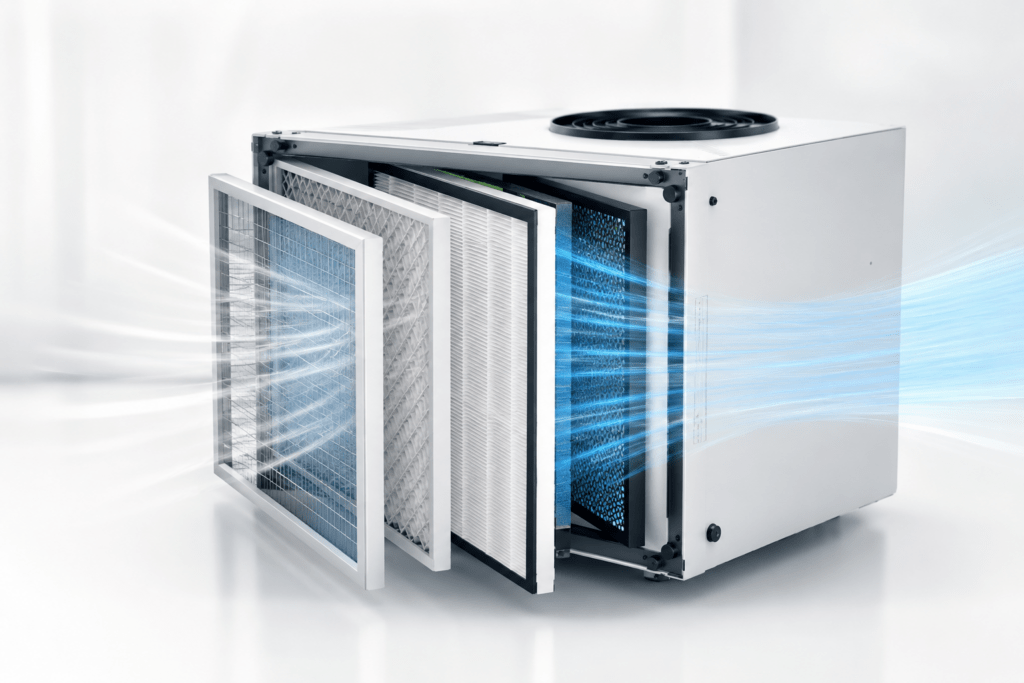
An air filter removes particles, gases, dust, bacteria, or pollutants from the air passing through it. The air goes in dirty. It comes out clean.
The best air filter for any situation depends on what you’re trying to remove:
- Mechanical filters trap physical particles — dust, pollen, PM2.5 — using fibre layers
- Activated carbon filters absorb gases, odours, and chemical vapours
- Electrostatic filters use electric charge to pull particles onto plates
- HEPA filters use dense glass-fibre media to capture particles as small as 0.3 microns
Each filter type targets a different problem. Using the wrong one means you’re filtering for something the air doesn’t have, while the actual pollutant passes through.
Best Air Filter Types Available in India
India has a wide range of air filter options — from simple pre-filters for HVAC systems to medical-grade HEPA units for hospitals. Here’s a complete breakdown of each type, what it does, and where it works best.
1. HEPA Filter — Best Air Filter for Home and Hospital Use
HEPA stands for High-Efficiency Particulate Air. A true HEPA filter captures 99.97% of particles at 0.3 microns or larger. That covers PM2.5, dust mites, pollen, mould spores, and airborne bacteria.
Where it’s used:
- Homes and apartments in high-pollution cities
- Hospitals, ICUs, and operation theatres
- Pharmaceutical cleanrooms
- HVAC systems in commercial buildings
Why it’s the best air filter for Indian homes: PM2.5 is the primary health threat in Indian cities. HEPA filters are the only residential-grade filter that actually captures these particles. Ordinary filters miss them entirely.
Replacement: Every 12 to 18 months depending on usage and pollution level.
2. Bag Filter — Best Air Filter for Heavy Industrial Dust
A bag filter uses fabric bags to capture dust and particulates from industrial air streams. The bags expand as air passes through, and dust collects on the outer surface.
Where it’s used:
- Cement plants
- Steel manufacturing
- Textile mills
- Food processing units
- Chemical factories
Bag filters handle high dust loads that would clog other filter types in hours. A single industrial bag filter unit can process thousands of cubic metres of air per hour. For heavy industrial dust applications, bag filters are consistently the best air filter option available.
Key spec to check: Filtration efficiency and bag material — polyester, polypropylene, or PTFE — depends on the temperature and chemical nature of the dust.
3. Pre-Filter — Best Air Filter for Extending System Life
A pre-filter is the first stage in any multi-stage filtration system. It catches large particles — hair, lint, coarse dust — before they reach finer downstream filters.
Where it’s used:
- HVAC systems (before HEPA or activated carbon stages)
- Industrial air handling units
- Air compressors and blowers
- Spray booths
Pre-filters extend the life of expensive downstream filters by 3 to 5 times. Without one, the best air filter in your system — whether HEPA or carbon — wears out far faster than it should.
Replacement: Every 1 to 3 months. These are cheap — don’t skip them.
4. Carbon Filter — Best Air Filter for Odour and Gas Removal
Activated carbon has millions of tiny pores that trap gas molecules, chemical vapours, and odours through adsorption.
Where it’s used:
- Kitchen exhausts and commercial kitchens
- Laboratories handling volatile chemicals
- Printing and painting workshops
- Air purifiers targeting VOCs and cigarette smoke
Carbon filters don’t capture particles. They target gases and odours. If you need the best air filter for both particles and gases, pair a carbon filter with a HEPA unit.
What they remove: Formaldehyde, benzene, ammonia, hydrogen sulphide, tobacco smoke, cooking odours, industrial solvent vapours.
Replacement: Every 6 to 12 months. Unlike particle filters, you can’t see when they’re saturated — replace on schedule.
5. High Temperature Filter — Best Air Filter for Furnaces and Kilns
Standard filter media degrades above 80°C. High temperature filters use materials — ceramic fibre, fibreglass, woven stainless steel mesh, or PTFE — that hold up in extreme heat.
Where it’s used:
- Furnaces and kilns
- Boilers and incinerators
- Foundries
- Glass manufacturing plants
- Hot gas filtration systems (up to 500°C+)
For any application involving extreme heat, this is the best air filter material available. Standard filters will simply fail.
Critical spec: Continuous operating temperature vs. peak temperature rating. A filter rated at 200°C continuous might survive a 280°C spike for 30 minutes — check both before specifying.
6. Medical Filter — Best Air Filter for Hospitals and Cleanrooms
Medical-grade filters meet strict microbiological standards. They remove bacteria, viruses, fungal spores, and other biological contaminants from air in healthcare settings.
Where it’s used:
- Operation theatres (OT)
- Intensive Care Units (ICU)
- Isolation rooms
- Pharmaceutical manufacturing cleanrooms
- Blood banks and pathology labs
Indian healthcare regulations under NABH and CPCB specify minimum filtration standards for hospital ventilation. OTs typically require HEPA H14 grade — the best air filter grade for infection control.
Key difference from standard HEPA: Medical filters go through additional testing for bacterial penetration and are manufactured in controlled conditions.
7. Room Air Purifier Filter — Best Air Filter for Indoor Air Quality
Room air purifiers combine multiple filter stages in a single unit — typically a pre-filter, HEPA layer, and activated carbon layer. For most Indian households, a good room purifier is the most practical best air filter solution.
Where it’s used:
- Bedrooms and living rooms
- Home offices
- Small commercial spaces
- Hotel rooms
What to check when buying:
- CADR (Clean Air Delivery Rate) — higher is faster
- Room coverage area in square feet
- HEPA grade — H11 is acceptable, H13 is better
- Carbon weight — more carbon means longer-lasting odour removal
In India, BEE star rating applies to purifiers with fans. A 5-star rated unit costs more upfront but saves on electricity over 3 to 5 years of daily use.
8. Cabin Filter — Best Air Filter for Car Interiors
Cabin filters sit in a vehicle’s HVAC system and clean the air coming into the passenger compartment. Most Indian cars use either a basic particulate filter or a combination particulate + carbon filter.
Signs your cabin filter needs replacing:
- Musty smell from AC vents
- Reduced AC airflow
- More dust visible on dashboard
- Allergy symptoms worsening during drives
Replacement interval: Every 15,000 to 20,000 km in Indian conditions. In Delhi or Mumbai, every 10,000 km is more realistic.
Upgrade option: If your car came with a basic filter, upgrade to a HEPA-grade cabin filter — the best air filter option for vehicle cabins in polluted cities. The difference in PM2.5 inside the cabin is significant.
9. Generator Air Filter — Best Air Filter for DG Sets
Generator engines pull in large volumes of air for combustion. Dust, sand, and particulates entering the intake accelerate cylinder wear and reduce engine life by years.
Where it’s used:
- DG sets in offices, hospitals, and factories
- Construction site generators
- Agricultural pumping sets
- Telecom tower backup generators
Filter types for generators:
- Dry paper filters — standard, low cost
- Oil bath filters — used in high-dust environments like construction sites
- Pre-cleaners — separate dust before it hits the main filter
Maintenance rule: Check and clean the filter every 50 to 100 running hours. Replace at manufacturer-specified intervals — typically every 250 to 500 hours.
10. Industrial Air Filter — Best Air Filter for Factories and Plants
Industrial air filters cover filtration equipment for factories, plants, and large commercial facilities. These handle higher flow rates, heavier dust loads, and more demanding conditions than any residential product.
Sub-types:
- Panel filters for AHUs
- Cartridge filters for dust collectors
- Mist eliminators for machining coolant mist
- Oil mist filters for compressor exhausts
Flow rate matters: Industrial filters are rated in cubic metres per hour (m³/hr). Undersizing causes early clogging and pressure drop issues. Always specify the best air filter size for your actual system airflow — not just the nominal rating.
11. Blower Air Filter and Air Compressor Filter
Blowers and compressors are sensitive to dust ingestion. Even fine particles cause bearing wear, seal failure, and compressor valve damage.
Blower filters are typically wrap-around or cartridge types fitted at the inlet.
Compressor filters include both inlet filters and compressed air filters (after the compression stage). Compressed air filters remove oil aerosols, water vapour, and fine particulates — critical for food processing, painting, and pneumatic tool applications.
ISO 8573 standard defines air quality classes for compressed air. Class 1 is the cleanest (0.1 micron, 0.01 mg/m³ oil, -70°C dew point). Match your filter spec to the ISO class your process requires.
Best Air Filter for Each Use Case: Quick Reference
| Application | Best Air Filter |
|---|---|
| Home in Delhi / high-pollution city | HEPA H13 room purifier |
| Hospital OT or ICU | Medical-grade HEPA H14 |
| Cement or steel plant | Bag filter with pre-cleaner |
| Car in polluted city | HEPA-grade cabin filter |
| Diesel generator | Dry paper + pre-cleaner |
| Kitchen with strong odours | Activated carbon filter |
| Factory furnace above 200°C | High temperature filter |
| HVAC system (office building) | Pre-filter + HEPA panel |
| Air compressor output | ISO 8573 compliant compressed air filter |
| Pharmaceutical cleanroom | HEPA H14 + ULPA |
How to Choose the Best Air Filter in India
Step 1: Identify what you’re filtering out
Particles, gases, and biological contaminants each need different technology. A carbon filter removes odours but passes PM2.5 straight through. A HEPA filter stops particles but ignores formaldehyde. Know the pollutant before choosing the best air filter for your space.
Step 2: Check the filtration efficiency rating
For HEPA filters, the European EN 1822 standard is the most common in India:
| Grade | Efficiency | Best For |
|---|---|---|
| H10 | 85% | Pre-filtration |
| H11 | 95% | General commercial use |
| H12 | 99.5% | Clean offices, labs |
| H13 | 99.95% | Homes, high-pollution areas |
| H14 | 99.995% | Hospitals, pharma cleanrooms |
For industrial filters, MERV rating (1 to 16) is also used. MERV 13 and above handles PM2.5. MERV 16 approaches HEPA performance.
Step 3: Match the airflow rate
A filter rated for 200 m³/hr put in a system pushing 500 m³/hr will have excessive pressure drop, bypass leakage, and fail early. Always size the best air filter 20 to 30% above your system’s actual airflow.
Step 4: Consider operating conditions
Temperature, humidity, chemical exposure, and dust load affect filter life. A filter designed for 25°C and 60% humidity degrades faster in a boiler room at 180°C and 90% humidity. Specify accordingly.
Step 5: Calculate total cost of ownership
The filter price is not the only cost. Factor in:
- Replacement frequency — a cheap filter replaced every month can cost more than a premium one lasting 18 months
- Energy cost — higher pressure drop = more fan energy
- Downtime cost — industrial filters that fail mid-production carry cost well beyond the filter price itself
Step 6: Verify certifications
For filters used in food, pharma, or healthcare: ask for test certificates. A filter claiming to be the best air filter with H13 HEPA rating, but without EN 1822 test data, is just a marketing label. Reputable manufacturers provide scan testing certificates for each filter unit.
Step 7: Evaluate the brand, not just the product
Filter specs on paper mean little if the brand can’t back them up. Before finalizing an air filter brand, check:
- Test certification history — does the brand provide EN 1822 or ISO 16890 test reports for the specific unit, or only generic marketing claims?
- Manufacturing standard — ISO-certified manufacturing facilities are more likely to maintain consistent filter quality batch to batch
- After-sales support — replacement filter availability, warranty terms, and service response time matter more once the unit is installed
- Industry experience — brands with a longer track record in industrial or medical-grade filtration typically have more rigorous quality control than newer consumer-only brands
- Custom engineering capability — for non-standard applications (industrial, pharma, hospital), a brand that can custom-engineer a solution is more valuable than one offering only fixed catalog sizes
A well-known air filter brand isn’t automatically the best air filter brand for your specific application — verify the certification and specs match your actual requirement before deciding on reputation alone.
Energy Efficient Air Filters: What Actually Saves Power
Filter efficiency and energy efficiency are two different things — and most buyers confuse them. A filter can capture 99.97% of particles and still cost you significantly more on your electricity bill, depending on how much resistance it creates against airflow.
What Makes an Air Filter Energy Efficient
Every filter creates resistance to airflow, called pressure drop. The higher the pressure drop, the harder the fan has to work to push air through — and the more electricity it consumes. An energy efficient air filter is designed to capture particles while keeping this resistance low.
Key factors that determine energy efficiency:
- Filter media design — pleated filters with more surface area create less resistance than flat, dense media for the same filtration level
- MERV/HEPA grade vs. airflow trade-off — higher filtration grades (H13, H14) generally increase pressure drop; manufacturers offset this with larger surface area designs
- BEE star rating — in India, room air purifiers with fans carry BEE star ratings (1 to 5 stars). A 5-star unit uses less electricity for the same CADR output compared to a 1-star or unrated unit
- Filter loading over time — a clogged filter, even an energy-efficient one by design, becomes energy-inefficient as dust accumulates and resistance rises
Running Cost Comparison
| Filter Type | Typical Power Draw | Notes |
|---|---|---|
| Basic 1-star purifier | 45–60W | Higher long-term electricity cost |
| 5-star rated HEPA purifier | 25–40W | Lower running cost, higher upfront price |
| Industrial HVAC pre-filter + HEPA combo | Varies by system | Pre-filter reduces load on HEPA stage, indirectly saving fan energy |
Why This Matters for Total Cost of Ownership
A cheaper, energy-inefficient filter often costs more over 3–5 years once electricity consumption is factored in — especially for units running continuously in homes, hospitals, or commercial spaces. When comparing options, check the BEE star rating alongside CADR and HEPA grade, not just the filtration percentage.
Best energy efficient air filter picks by use case:
- Home use: 5-star BEE rated HEPA room purifier
- Continuous hospital/ICU use: Fixed HVAC-integrated HEPA with low pressure-drop pleated design
- Industrial HVAC systems: Pre-filter + HEPA combination to reduce load on the energy-intensive final stage
Air Filter Maintenance: Key Rules
Change on schedule, not just on appearance. Activated carbon saturates invisibly. HEPA filters can look clean while operating above safe pressure drop. Even the best air filter fails if not replaced on time.
Track pressure differential. Most industrial filter housings have differential pressure gauges. Replace when pressure drop exceeds the manufacturer’s limit — not before, not long after.
Check seals on every replacement. A perfectly good filter with a poor gasket seal lets air bypass around the filter. All filtration efficiency numbers assume a proper seal.
Keep a replacement log. Track install date, running hours, and pressure readings. This gives you real-world data on replacement intervals for your specific environment.
Why Choosing the Best Air Filter Matters More in India Now
India’s industrial output has grown significantly over the past decade. So has vehicular density in cities. CPCB’s 2024 data shows that 142 of India’s 193 monitored cities exceeded safe annual PM2.5 limits.
Indoor air quality regulations for commercial buildings and hospitals are tightening. IGBC (Indian Green Building Council) and GRIHA rating systems now include indoor air quality as a scored parameter. Buildings with the best air filter systems installed score higher and attract better tenants.
For industry, CPCB emission norms for stack emissions and ambient air quality have pushed factories to upgrade their filtration systems or face penalties.
Good filtration is no longer optional in many sectors — it’s a compliance requirement.
About Fiilters.com — Best Air Filter Manufacturer in India
Fiilters.com is a Delhi-based air filter manufacturer with 10+ years of experience. ISO certified, the company manufactures all major filter types under one facility:
- HEPA filters (H10 to H14)
- Bag filters for industrial applications
- Pre-filters, carbon filters, high temperature filters
- Medical-grade filters for healthcare
- Cabin filters, generator filters, compressor filters
- Custom filtration solutions for specific industrial needs
Whether you need the best air filter for a single room or an entire industrial plant, Fiilters.com provides products with verified test data and custom-engineered solutions for non-standard requirements.
Contact Fiilters.com to discuss your requirement or request a product specification sheet.
Frequently Asked Questions About the Best Air Filter in India
Which is the best air filter for home use in India?
A room air purifier with an H13 HEPA filter is the best air filter for most Indian homes. Look for a CADR rating that covers your room size — generally 5x the room area in square feet per hour.
Which is the best air filter brand in India?
ISO-certified Indian manufacturers like Fiilters.com produce filters meeting the same EN 1822 and ISO 16890 standards as European or US brands. Always request test certificates — that’s what separates a genuinely good product from a marketing claim.
How often should I replace the best air filter at home?
Every 12 to 18 months under normal use. In high-pollution cities like Delhi, Kanpur, or Lucknow — every 8 to 12 months.
What’s the difference between an industrial and home air filter?
Flow rate, dust load capacity, and build materials. Industrial filters handle thousands of m³/hr and heavy particulate loads. The best air filter for a home handles 200 to 600 m³/hr in relatively clean conditions.
Can I clean and reuse a HEPA filter?
Most HEPA filters are not designed for washing. Washing damages the fibre structure and drops efficiency permanently. Some washable pre-filters exist, but true HEPA media should be replaced, not cleaned.
What is the best air filter for a factory with high dust?
Start with a pre-cleaner, then a bag filter for primary dust collection, then a panel HEPA filter on any air supply going into occupied or sensitive areas. The exact spec depends on dust type and airflow volume.
Contact Best Air Filters
- WhatsApp: 96255 55709
- Email: bafcustomercare@gmail.com
- Factory: 197/3, Gali No. 3, Padam Nagar, Sarai Rohilla, Delhi, 110007, India
For product enquiries, custom filtration projects, or specification support, visit fiilters.com or contact the team directly.