
Pharmaceutical Filtration Guide: Everything About Pharma Filters
Pharmaceutical manufacturing is one of the most regulated industries in the world — and for good reason. A single contaminated batch can harm thousands of patients. That’s where pharma filters come in.
Pharma filters also known as pharmaceutical filters — are specialized filtration devices used throughout drug manufacturing to remove particles, microorganisms, and contaminants from liquids, gases, and air. They don’t just improve product quality — they protect lives.
In this guide, we cover everything you need to know about pharma filters: what they are, how they work, the different types used in pharmaceutical manufacturing, and how to choose the right one for your application. one for your application.
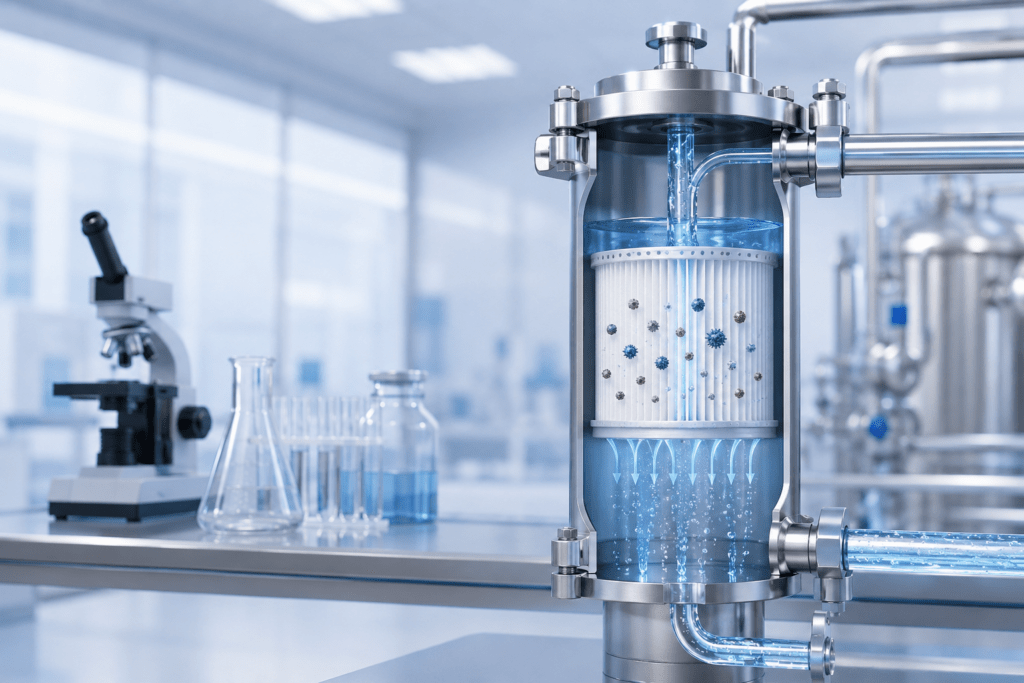
What Are Pharma Filters?
Definition and Basic Concept
Pharma filters are precision filtration tools designed specifically for use in pharmaceutical environments. They remove unwanted particles — from large debris down to bacteria and viruses — from liquids, gases, and air streams during drug production.
Unlike standard industrial filters, pharma filters meet strict regulatory standards. They’re made from materials that don’t react with drug compounds, don’t shed particles into the product (extractables and leachables testing), and can withstand steam sterilization or chemical sanitization.
The goal is simple: ensure that what goes into the patient’s body is pure, sterile, and exactly what it’s supposed to be.
How Pharma Filters Work
The working mechanism depends on the filter type, but most pharma filters operate on one or more of these principles:
Size exclusion: Particles larger than the filter’s pore size physically cannot pass through. A 0.2-micron membrane filter, for example, stops bacteria (which are typically 0.5–10 microns in size).
Depth filtration: Instead of a single barrier, depth filters trap particles throughout their thickness using adsorption and mechanical entrapment. This works well for removing a wide range of particle sizes from high-volume streams.
Electrostatic attraction: Some filters carry a charge that attracts and holds charged particles, even ones smaller than the pore size.
Adsorption: Certain filter media chemically bind specific contaminants, pulling them out of the product stream.
In practice, many pharmaceutical processes use multiple filter types in sequence — a depth filter first to remove bulk contaminants, then a membrane filter for sterilization.
Common Materials Used
Filter media choice depends on the product being filtered, process conditions, and regulatory requirements. Common materials include:
- Polyethersulfone (PES): Low protein binding, high flow rates. Common in biotech and sterile filtration.
- Polyvinylidene fluoride (PVDF): Chemically resistant, good for aggressive solvents.
- Nylon: Aqueous and mild solvent applications.
- Cellulose acetate: Traditional membrane material, still used in some applications.
- Borosilicate glass fiber: Standard material for depth filters; excellent dirt-holding capacity.
- Polypropylene: Used in cartridge filters for broad chemical compatibility.
- PTFE (Teflon): For highly corrosive chemicals and gas filtration.
Importance of Filtration in Pharmaceutical Industry
Product Purity and Safety
Drug products — especially injectables, ophthalmic solutions, and biologics — must be free of particles that could cause patient harm. Particles in an IV solution can cause phlebitis, pulmonary embolism, or worse.
Filtration in pharmaceutical industry processes removes:
- Particulate matter (dust, metal fines, raw material debris)
- Microbial contaminants (bacteria, yeast, mold)
- Endotoxins and pyrogens (in some specialized filtration steps)
- API aggregates that could trigger immune responses in biologics
No other manufacturing step can reliably replace filtration for achieving this level of purity.
Contamination and Microbial Control
Microbial contamination in a pharmaceutical product is a patient safety crisis. For sterile products (injectables, eye drops, wound care), even a single viable microorganism in a dose is unacceptable.
Sterile filtration through 0.2-micron membrane filters is the primary method to sterilize products that can’t be terminally sterilized by heat or radiation. This step is critical for heat-sensitive biologics, protein-based drugs, and many liquid formulations.
Beyond the product itself, filtration also controls the manufacturing environment — HEPA filters in cleanrooms remove 99.97% of airborne particles ≥0.3 microns, preventing environmental contamination of open product during filling.
Regulatory Compliance: FDA, GMP, and WHO
Regulatory agencies don’t just recommend filtration — they require it.
FDA: 21 CFR Part 211 mandates that pharmaceutical manufacturers control contamination in sterile products. FDA guidance documents specifically address sterilizing filtration.
GMP (Good Manufacturing Practice): Both EU GMP and US GMP guidelines require validated filtration processes with documented filter integrity testing before and after use.
WHO: WHO Technical Report Series guidelines on sterile pharmaceutical products require sterilizing-grade filtration validated to remove Brevundimonas diminuta at a minimum challenge of 10⁷ organisms per cm².
USP <1229.5>: The United States Pharmacopeia provides specific guidance on sterilizing filtration, including membrane filter validation.
Failure to comply leads to warning letters, product recalls, and facility shutdowns. Filtration records are a standard part of every batch record reviewed during FDA inspections.
Batch-to-Batch Quality Consistency
Filtration also ensures consistency. If particles or impurities vary batch to batch, the product’s performance and stability can vary too. A validated filtration process with documented integrity testing gives manufacturers confidence that every batch meets the same specification.
This consistency matters for regulatory submissions — a process that produces variable results won’t get approved.
Types of Pharma Filters Used in Filtration Process
Membrane Filters
Membrane filters are thin polymeric sheets with precise, uniform pore sizes. They work by size exclusion — particles larger than the pore size are retained on the membrane surface.
Key specifications:
- Pore sizes: 0.1, 0.2, 0.45, 0.8, 1.0 microns (most common)
- 0.2-micron filters are the standard for sterilizing filtration
Use cases:
- Sterile filtration of injectable drugs, biologics, and ophthalmic solutions
- Bioburden reduction
- Clarification of clear solutions
- Laboratory testing and quality control
Materials: PES, PVDF, cellulose acetate, nylon — chosen based on drug compatibility.
Depth Filters
Depth filters are thick pads or sheets of fibrous material. Unlike membrane filters, they trap particles throughout their entire thickness rather than just on the surface. This gives them high dirt-holding capacity.
Key specifications:
- No single defined pore size — rated by nominal retention
- Available in various grades for different particle size ranges
Use cases:
- Primary clarification (removing large particles early in the process)
- Removing cell debris and protein aggregates in bioprocessing
- Pre-filtration before membrane filters to extend membrane life
- Processing high-turbidity feeds like fermentation broths or cell culture harvests
Materials: Borosilicate glass fiber, cellulose, diatomaceous earth, polypropylene.
Cartridge Filters
Cartridge filters are self-contained filter elements that fit into reusable housings. They can use membrane, depth, or pleated filter media inside a cylindrical cartridge design.
Key specifications:
- Standard sizes: 10″, 20″, 30″, 40″ lengths
- Pleated design increases surface area, improving flow rates and capacity
Use cases:
- Large-scale liquid filtration in pharmaceutical production
- Pre-filtration and final filtration steps
- Water purification systems (WFI, purified water)
- Gas and vent filtration on tanks and fermenters
Advantages: Easy to change, scalable from pilot to production scale, available in sterilizable formats.
HEPA Filters in the Pharmaceutical Industry
HEPA (High Efficiency Particulate Air) filters capture 99.97% of airborne particles ≥0.3 microns. They don’t filter liquids — their job is cleanroom air quality and environmental control.
Key specifications:
- Efficiency: 99.97% at 0.3 microns (HEPA), 99.9995% (ULPA)
- Installed in air handling units and laminar flow workstations
Use cases:
- Cleanroom air supply in manufacturing areas
- Laminar airflow (LAF) workbenches for aseptic processing
- Isolators and RABS (Restricted Access Barrier Systems)
- Fermentation exhaust filtration
Why it matters: Open product during filling is exposed to room air. HEPA filtration of that air is the last line of defense against airborne contamination.
Sterile vs Non-Sterile Filters
This distinction matters more than the filter type itself.
Sterile filters are pre-sterilized (typically by gamma irradiation), individually packaged, and validated for use in direct product contact during sterile manufacturing. They come with certificates of sterilization and extractables data.
Non-sterile filters are used upstream — in raw material processing, water systems, or gas filtration — where product sterility isn’t yet the concern. They may be sanitized by steam, but haven’t been validated as sterilizing-grade.
Using a non-sterile filter as the final sterilizing filter is a GMP violation.
How Filtration Works in Pharmaceutical Manufacturing
Step-by-Step Filtration Process
Filtration doesn’t happen at one stage — it runs throughout the entire manufacturing process, from raw materials to the finished product.
Stage 1 — Raw material processing: Bulk APIs and excipients may be dissolved, and the resulting solutions are pre-filtered to remove insoluble particles and residues before they enter the formulation step.
Stage 2 — Bulk formulation: The drug product is compounded — API mixed with excipients in water for injection (WFI) or another vehicle. This bulk solution goes through clarification filtration (typically 0.45 or 0.8 microns) to remove particulates and reduce bioburden.
Stage 3 — Bioburden reduction: A bioburden-reduction filter (0.2 or 0.45 micron) brings microbial counts down before the final sterilizing filtration step. This protects the final filter from overloading.
Stage 4 — Sterilizing filtration: The bulk solution passes through a validated 0.2-micron sterilizing-grade filter into a sterile holding vessel. This is the critical step. Filter integrity testing (bubble point or diffusion test) happens before and after this filtration.
Stage 5 — Filling: Product is filled into sterile containers (vials, syringes, ampoules) under HEPA-filtered laminar airflow. The environment is classified ISO 5 or better.
Stage 6 — Post-fill testing: Filled containers undergo particle inspection (manual or automated), sterility testing, and container closure integrity testing.
Different Manufacturing Stages: API, Formulation, Packaging
API production: Filtration separates the active ingredient from synthesis byproducts, removes catalysts and impurities, and clarifies solutions before drying or crystallization.
Formulation: This is where most of the pharma filter action happens — clarification, bioburden reduction, and sterilizing filtration all happen in this stage.
Packaging: Air filtration (HEPA) protects open containers and product during fill-finish. Packaging areas for sterile products maintain ISO 5–7 classifications using filtered air.
Sterile Filtration vs Clarification Filtration
These two serve different purposes.
Clarification filtration removes visible and sub-visible particles to make a solution clear. Pore sizes are typically 0.45–10 microns. It does not sterilize. Clarification happens before the final sterile filtration step.
Sterile filtration (sterilizing filtration) removes bacteria to produce a sterile product. This requires 0.2-micron (or tighter) validated membranes. The filter must have passed validation testing using Brevundimonas diminuta bacterial challenge. Only sterile filtration can claim to sterilize a product.
Many processes use both: clarification first to protect the expensive sterilizing-grade membrane, then sterilizing filtration as the terminal step.
Equipment and Technology Used
Modern pharmaceutical filtration uses:
- Stainless steel filter housings (316L SS) — autoclavable, CIP/SIP compatible
- Single-use filter assemblies — pre-assembled, gamma-irradiated, eliminates cleaning validation
- Integrity testers — automated devices (Millipore Integritest, Sartorius Sartocheck) that run bubble point and diffusion tests
- Tangential flow filtration (TFF) systems — for concentration and diafiltration of biologics
- Normal flow filtration skids — automated process equipment for large-scale filtration
Single-use technology has grown significantly in bioprocessing because it reduces the risk of cross-contamination and eliminates cleaning validation for the filter assembly.
Benefits of Using Quality Pharma Filters
Product safety: Removes microbial and particulate contamination that would make a product unsafe for patients.
Regulatory compliance: Validated filtration processes are required by FDA, EMA, WHO, and ICH guidelines. Quality filters make compliance achievable.
Cost efficiency: Pre-filtration and depth filters protect expensive sterilizing membranes, extending their life and reducing replacement costs. Filter failures cost far more than the filters themselves.
Extended shelf life: Removing microbial contamination and particulates prevents product degradation, supporting longer shelf-life claims.
Batch release confidence: Integrity-tested filtration gives manufacturers documented evidence that the sterilizing step worked, supporting batch release decisions.
Common Challenges in Pharmaceutical Filtration
Clogging and Filter Blinding
High-viscosity solutions, turbid feeds, or fine particles can quickly clog membrane filters, driving up pressure and stopping flow before the batch is complete. Solutions include pre-filtration with depth filters, running at lower pressure, or increasing filter area.
Filter Integrity Testing Failures
A failed integrity test after filtration means the batch may not be sterile — a potential rejection. Common causes: membrane damage from excessive pressure, incompatible solvents, improper wetting, or improper handling during installation. Pre-use integrity testing catches a bad filter before the product passes through it.
Scale-Up Issues
A filtration process that works at 10 liters may not directly scale to 1,000 liters. Pressure drop, flow rate, and filter loading all behave differently at scale. Proper scale-up studies (using Vmax and filter capacity testing) are needed before commercial manufacturing.
Extractables and Leachables
Filter materials can release trace chemicals into the product under process conditions. These must be characterized through extractables and leachables (E&L) studies. Regulatory agencies — especially for injectables and biologics — expect this data in the submission package.
Regulatory Documentation
Every sterilizing filtration step needs a validation file: bacterial retention validation, flow/flux characterization, integrity test limits, and compatibility data. Assembling this documentation is time-consuming but non-negotiable.
How to Choose the Right Pharma Filter
Choosing the wrong filter wastes time, money, and potentially invalidates a batch. Here’s what to evaluate:
1. Pore size: Start with the application. Sterilizing filtration requires 0.2 microns. Clarification may use 0.45–1.0 microns. Particle removal in API processing may use larger pores.
2. Filter media material: Match the membrane material to your solvent system. PES for aqueous solutions, PVDF or PTFE for aggressive solvents, nylon for general use. Run a compatibility test if unsure.
3. Filter format: Single-use capsule for small volumes or clinical manufacturing; cartridge filter in stainless housing for large-scale production; disc filter for lab-scale.
4. Regulatory compliance: Confirm the filter has a vendor validation guide, bacterial retention data (for sterilizing grade), and USP Class VI biocompatibility certification.
5. Process conditions: Check maximum operating pressure, temperature range (especially if steam sterilization is planned), and flow rate requirements.
6. Extractables and leachables data: For injectable products, the filter vendor should supply E&L data. This is reviewed during regulatory submissions.
7. Filter sizing: Use filter sizing studies (Vmax testing) to determine the right filter area for your batch volume and feed characteristics. Undersized filters fail mid-batch.
Frequently Asked Questions
What is a sterilizing-grade filter?
A sterilizing-grade filter is a membrane filter (typically 0.2 microns) validated to remove 100% of Brevundimonas diminuta bacteria at a challenge of ≥10⁷ CFU/cm² of filter area. Only filters that have passed this validation can be used as the final sterile filtration step for pharmaceutical products.
What is filter integrity testing, and why is it required?
Filter integrity testing (bubble point test or diffusion test) confirms that the membrane is intact and has not been damaged before or after use. It’s required by GMP regulations because a compromised membrane cannot guarantee sterility. FDA and EU GMP both mandate pre- and post-use integrity testing for sterilizing filtration steps.
What is the difference between a 0.2-micron and a 0.45-micron filter?
A 0.2-micron filter removes bacteria and is used for sterilizing filtration. A 0.45-micron filter removes larger particles and reduces bioburden but is not considered sterilizing-grade. In most sterile processes, 0.45-micron filters are used as pre-filters before the final 0.2-micron sterilizing filter.
Can all pharmaceutical products be sterilized by filtration?
No. Filtration sterilizes liquids and gases — it doesn’t work for solid dosage forms (tablets, capsules). It’s also not suitable for products that are too viscous or contain particles that would be removed by the filter. Solid products are typically sterilized by dry heat, steam, gamma irradiation, or ethylene oxide.
What is single-use filtration, and when should I use it?
Single-use filtration uses pre-assembled, gamma-irradiated, disposable filter assemblies that are discarded after one use. They eliminate cleaning validation for the filter train, reduce contamination risk between batches, and speed up changeover. They’re especially valuable in multiproduct facilities and clinical/biopharmaceutical manufacturing.
Conclusion
Filtration in the pharmaceutical industry is not optional — it’s the backbone of drug safety, product quality, and regulatory compliance. Pharma filters do the critical work of removing particles, microorganisms, and contaminants that no other process step can reliably handle.
The key takeaways:
- Pharma filters serve different purposes at different manufacturing stages — from raw material clarification to final sterile filtration
- The right filter type depends on pore size, media compatibility, process scale, and regulatory requirements
- Integrity testing, validation documentation, and regulatory compliance are non-negotiable for sterilizing filtration steps
- Single-use technology and pre-filtration strategies reduce costs and improve reliability
Whether you’re setting up a new filtration process or optimizing an existing one, working with a filtration partner who understands pharmaceutical requirements makes the difference between a validated process and a compliance problem.
Need help selecting the right pharma filter for your application? Contact our team to discuss your process requirements and get expert filtration recommendations.