
Automotive Industry Air Filter Manufacturer | Best Air Filters
Introduction
Clean air affects almost every part of automotive work. A vehicle engine needs clean air to run well. A paint booth needs clean air to avoid surface defects. A manufacturing floor needs clean air to protect workers and equipment.
Dust, metal particles, smoke, and fine particulate matter cause real problems across the automotive sector. They wear down engines, contaminate paint finishes, damage sensors, and raise the rate of equipment failure.
This is why vehicle manufacturers, repair shops, and parts suppliers all depend on an automotive industry air filter manufacturer that understands these different applications. The air filter for automotive market spans everything from engine intake filters to cabin filters to industrial HVAC systems — each with its own contamination profile and performance requirement. The right filter, in the right place, removes a long list of operational headaches before they start.
This guide covers what automotive air filters do, where they get used, the main filter types, and the factors that separate a strong filtration product from an average one.
What is an automotive air filter?
An automotive air filter removes airborne contaminants from air before that air reaches an engine, a vehicle cabin, a piece of manufacturing equipment, or a building’s HVAC system.
The automotive industry does not use one filter for everything. A combustion engine needs a filter built for intake air. A paint booth needs a filter built to catch overspray. A grinding station needs a filter built for fine metal dust.
Each of these jobs needs its own filter design, its own filtration media, and its own micron rating.
Good filtration gives:
- Cleaner production environments
- Better vehicle performance
- Longer equipment life
- Lower maintenance costs
- Safer working conditions
How automotive air filtration works
Filtration captures contaminants before they reach sensitive equipment, an engine, or a person’s lungs. A filter’s media, the material the air passes through, traps particles of a certain size while letting air flow through.
Some filtration media catch large particles only, like dust and lint. Other media, like HEPA-grade material, catch particles as small as 0.3 microns. The right choice depends on what the application needs to remove.
Common contaminants in automotive settings include:
- Dust and dirt
- Metal shavings
- Smoke and fumes
- Paint overspray
- Pollen
- Fine particulate matter
Why filtration matters in this industry
Automotive manufacturing runs on tight quality control. A speck of dust on a wet paint surface can cause a rejected panel. A grain of metal dust in a sensitive sensor housing can cause a failed component.
A small amount of airborne contamination, left unmanaged, leads to:
- Surface defects on painted parts
- Higher product rejection rates
- More frequent equipment maintenance
- Slower production schedules
Clean air keeps these problems out of the process. Plants with strong filtration tend to see fewer line stoppages and steadier output over time.
Where air filters get used across automotive operations
Engine protection
A vehicle engine pulls in a constant stream of outside air for combustion. Without a filter, dust and abrasive particles would enter the cylinders and wear down pistons, rings, and cylinder walls within a short time.
An engine air filter stops that. It catches debris before the intake system, which protects the engine and extends the life of internal parts.
Clean air for production lines
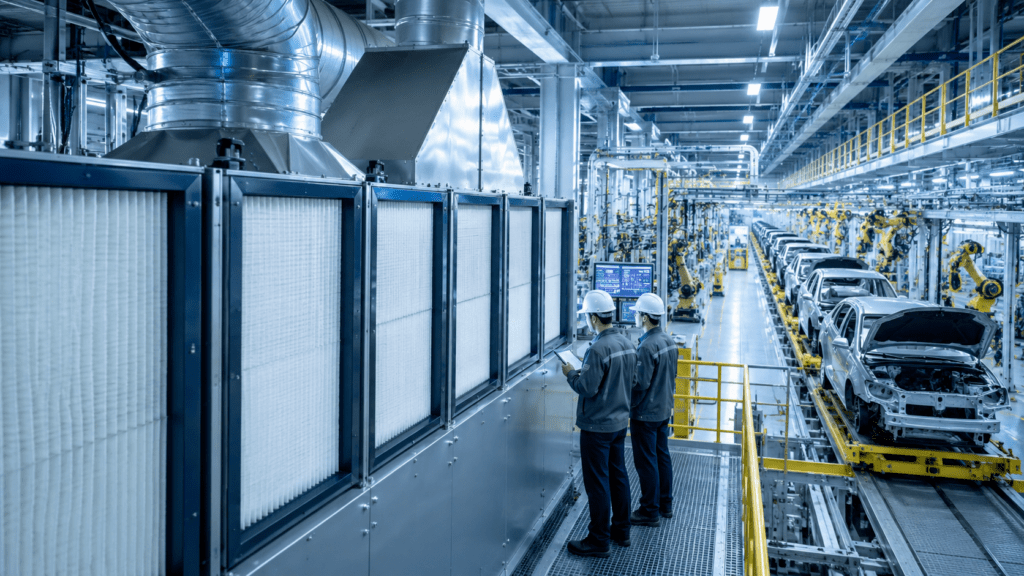
Assembly lines, paint shops, and testing facilities all need controlled air quality. Even a small rise in airborne dust can cause defects on a freshly painted body panel or contaminate a sensitive electronic component before it ships.
Filtration systems built into a plant’s HVAC and ventilation setup keep these areas within the air quality range the process needs.
Dust and particle control on the shop floor
Machining, welding, grinding, and metal stamping all generate heavy amounts of airborne dust. Without proper extraction and filtration, that dust settles on machinery, drifts into other work areas, and lowers visible air quality across the building.
Industrial filtration and dust collection systems pull this material out of the air before it spreads.
Equipment protection
Dust buildup is hard on motors, sensors, conveyor systems, and HVAC units. It blocks airflow, raises operating temperatures, and forces more frequent maintenance.
Clean air keeps this equipment running closer to its designed lifespan, with fewer unplanned repairs.
Main types of air filters used in the automotive industry
| Filter type | Application | Main benefit |
|---|---|---|
| Engine air filter | Vehicle engine | Engine protection |
| Cabin air filter | Passenger cabin | Cleaner air |
| HEPA filter | Paint booths | Fine particle removal |
| Activated carbon filter | VOC control | Odor removal |
| Dust collection filter | Manufacturing plants | Dust control |
Engine air filters
Engine air filters sit in a vehicle’s intake system and stop dust, sand, and debris from reaching the combustion chamber.
A good engine air filter gives:
- More stable engine performance
- Better fuel efficiency
- Less wear on internal parts
- A longer service interval
Most passenger cars, trucks, and commercial vehicles use a pleated paper or synthetic media engine filter, replaced on a set mileage schedule.
As an air filter manufacturer serving the full automotive spectrum, Best Air Filters builds engine air filters to match OEM specifications as well as custom housing dimensions for non-standard engines, off-road equipment, and commercial vehicle fleets — alongside the cabin, HEPA, industrial, and dust collection filters covered elsewhere on this page. Filter media, pleat count, and micron rating are selected based on each application’s specific airflow requirement, not a one-size-fits-all catalog part.
Cabin air filters
A cabin air filter cleans the air that enters the passenger compartment through the HVAC system. It catches dust, pollen, smoke particles, and road pollution before they reach the driver and passengers.
Newer vehicles increasingly use activated carbon cabin filters, which also cut down odors from traffic and exhaust.
Industrial air filters
Manufacturing plants use industrial air filters inside HVAC and ventilation systems to manage dust, fumes, and other airborne byproducts of production.
These filters protect both the air quality inside the building and the equipment that depends on clean intake air.
HEPA filters
A HEPA filter captures at least 99.97% of particles down to 0.3 microns in size. That level of efficiency makes HEPA filtration the standard choice for:
- Cleanrooms
- Paint preparation booths
- Electronics assembly areas
- Any process with strict contamination limits
Activated carbon filters
Activated carbon filters remove gases, odors, and volatile organic compounds (VOCs) rather than solid particles. Paint booths, solvent storage areas, and chemical handling rooms rely on these filters to keep odor and fume levels under control.
Dust collection filters
Dust collection filters work as part of larger extraction systems in welding bays, grinding stations, and metal finishing areas. They pull contaminated air at the source, before it spreads through the building, and trap the dust for safe disposal.
What separates a good air filter from an average one
Filtration efficiency
A filter’s job is to catch contaminants without choking off airflow. Efficiency should match the application: a cabin filter does not need HEPA-level performance, but a cleanroom does.
Pressure drop
Pressure drop measures how much resistance a filter puts on airflow. A filter with low pressure drop lets a system run with less strain on its fans and motors, which cuts energy use and keeps HVAC performance steady.
Service life
A filter that holds up longer between replacements lowers labor and material costs over time. Service life depends on the filter media, the dust load in the area, and how well the filter was sized for the job in the first place.
Filter media quality
Common filtration media include synthetic fiber, glass fiber, activated carbon, and nanofiber blends. Each one suits a different contamination level and airflow requirement, so the media has to match the actual operating environment, not just the budget.
Consistent performance
A filter that loses efficiency halfway through its rated life puts a plant at risk of failing its own quality checks. Reliable filtration holds steady output through the entire service period, which keeps both compliance and production planning on track.
The Automotive Market for Air Filters: Where Demand Comes From
The air filter for automotive market isn’t a single, uniform demand — it’s built from several distinct buyer segments, each with different volume needs and specifications:
- OEM production lines — high-volume, tightly specified filters built into the vehicle manufacturing process itself
- Aftermarket and service centers — replacement filters sold through repair shops, dealerships, and parts retailers
- Fleet operators — bulk, recurring filter demand tied to scheduled maintenance across large vehicle fleets
- Component and parts suppliers — filtration built into sub-assemblies before they reach the final vehicle
“As an air filter manufacturer serving the full automotive spectrum, Best Air Filters builds engine air filters to match OEM specifications as well as custom housing dimensions for non-standard engines, off-road equipment, and commercial vehicle fleets — alongside the cabin, HEPA, industrial, and dust collection filters covered elsewhere on this page. Filter media, pleat count, and micron rating are selected based on each application’s specific airflow requirement, not a one-size-fits-all catalog part.”
Industries that depend on automotive air filtration
OEM assembly plants, body shops, fleet maintenance operations, and parts suppliers each pull from automotive filtration in their own way.
- OEM vehicle assembly plants need filtration for paint booths, welding bays, and general HVAC, since even minor contamination can fail a quality check on a finished vehicle.
- Tier-1 and tier-2 component suppliers, especially those making sensors, wiring harnesses, or electronics, need cleanroom-grade or near-cleanroom air to protect sensitive parts during assembly.
- Fleet maintenance and repair shops go through engine and cabin filters on a regular replacement cycle, often tied to mileage or service intervals set by the vehicle manufacturer.
- Electric vehicle battery production adds its own filtration demand, since battery cell assembly needs strict control over dust and humidity to avoid contamination inside the cell.
Each of these settings has a different contamination profile. That difference is why a single filter design rarely works across all of them, and why an automotive industry air filter manufacturer usually offers more than one product line.
Choosing the right automotive industry air filter manufacturer
Picking a supplier is not only about price. A manufacturer with real experience building filters for engines, cabins, and industrial settings will know how filter media, pleat design, and housing size affect real-world performance, not just lab numbers.
Questions worth asking before choosing a manufacturer:
- Does the manufacturer test filters for the specific application, not a generic spec sheet?
- Can the manufacturer build custom sizes and ratings for unusual equipment?
- Is the supply chain steady enough to avoid production delays?
- Does the manufacturer hold relevant certifications for the industry?
A manufacturer that can answer these clearly has usually done this work for a long time, across more than one type of automotive application.
Why work with Best Air Filters?
Best Air Filters builds filtration products for vehicle engines, cabins, and industrial automotive operations, with a few things that set the work apart:
- Custom filter sizes for non-standard housings and equipment
- OEM manufacturing for vehicle and component brands
- Bulk supply capability for fleets and production plants
- Fast delivery to keep production and repair schedules on track
- Technical consultation to match filter specs to the actual application
- Replacement filter support for ongoing maintenance programs
Reach out with your engine, cabin, or facility filtration requirements, and the team will recommend a filter built for the actual job, not a generic catalog match.
Common questions about automotive air filters
How often should an engine air filter be replaced?
Most manufacturers recommend replacement every 12,000 to 15,000 miles, though dusty or off-road driving conditions can shorten that interval.
What is the difference between OEM and aftermarket filters?
OEM filters match the exact specification set by the vehicle manufacturer. Aftermarket filters can match or, in some cases, exceed OEM filtration ratings, but quality varies by manufacturer, so test data matters more than the label on the box.
Can a dirty air filter affect fuel efficiency?
Yes. A clogged engine air filter restricts airflow to the engine, which can lower fuel efficiency and cut engine power output.
Do industrial facilities need different filters for different seasons?
In some climates, yes. Higher pollen counts or dust storms in certain seasons can call for higher-capacity prefilters ahead of the main filtration stage.
Why this level of detail matters
Google’s own guidance for content creators, “Creating helpful, reliable, people-first content,” asks a direct question: does a page show first-hand experience and depth of knowledge, or does it just repeat generic claims dressed up as advice?
That standard fits filtration content the same way it fits any technical topic. A page on automotive air filters should come from people who understand filtration media, micron ratings, and real production environments, not from keyword research alone.
This matters for readers too. A buyer choosing a filter for an engine, a paint booth, or a dust collection system needs specific, accurate information, not a generic sales pitch with a few keywords added in.
Why automotive manufacturers trust quality filtration
- Consistent production quality
- Lower maintenance costs
- Better equipment reliability
- Cleaner working environment
- Improved regulatory compliance
These outcomes are why plant managers treat filtration as part of the production process itself, not as a separate maintenance line item.
Final thoughts
Automotive air filtration touches engines, cabins, paint booths, machining floors, and entire HVAC systems. Each application needs a filter built for its own contamination type, airflow rate, and efficiency target.
Picking the wrong filter rarely shows up as a single, obvious failure. It shows up as a slightly higher rejection rate on the paint line, an engine that loses a bit of power earlier than expected, or a motor that needs servicing more often than it should. Over a year of production or driving, those small losses add up to a real cost.
Best Air Filters builds and supplies filtration products across these categories, from engine and cabin filters to industrial, HEPA, activated carbon, and dust collection systems. The team works with plant managers and procurement teams to match filter specifications to the actual contamination load on site, not just a catalog part number.
For vehicle owners, repair shops, and manufacturing facilities alike, the goal stays the same: clean air where it matters, at a cost that makes sense for the operation. Get in touch for a filter recommendation suited to your specific application.