
Turbo Air Filter Manufacturer: CFM-Rated Filters
Last updated: August 2026
Last updated: August 2026 By Neeraj Goel, filter manufacturer with 10+ years of experience in industrial and automotive filtration
Who this guide is for: Car owners, mechanics, tuners, and procurement teams who are choosing, sizing, or sourcing an air filter for a turbocharged engine — whether that’s a mild factory turbo setup, a full aftermarket cold-air intake build, or a bulk OEM/custom order for a fleet or manufacturing use case.
Quick answer
A turbocharged engine doesn’t automatically need a special filter category — it needs a filter sized for peak CFM demand at boost, not just displacement. Match the filter’s rated airflow to your turbo’s maximum flow (Garrett recommends a face velocity of 130 ft/min or lower at redline), confirm exact fitment (flange, height, diameter), and pick oiled vs. dry based on how much maintenance you’re willing to do. Mild setups usually do fine with a properly rated panel filter in the stock airbox; higher-boost or aftermarket builds usually need a cone filter with a heat shield.
Key takeaway: Undersizing filter area for your turbo’s CFM requirement — not the filter “type” — is the single biggest cause of restriction, reduced turbo life, and lost boost.
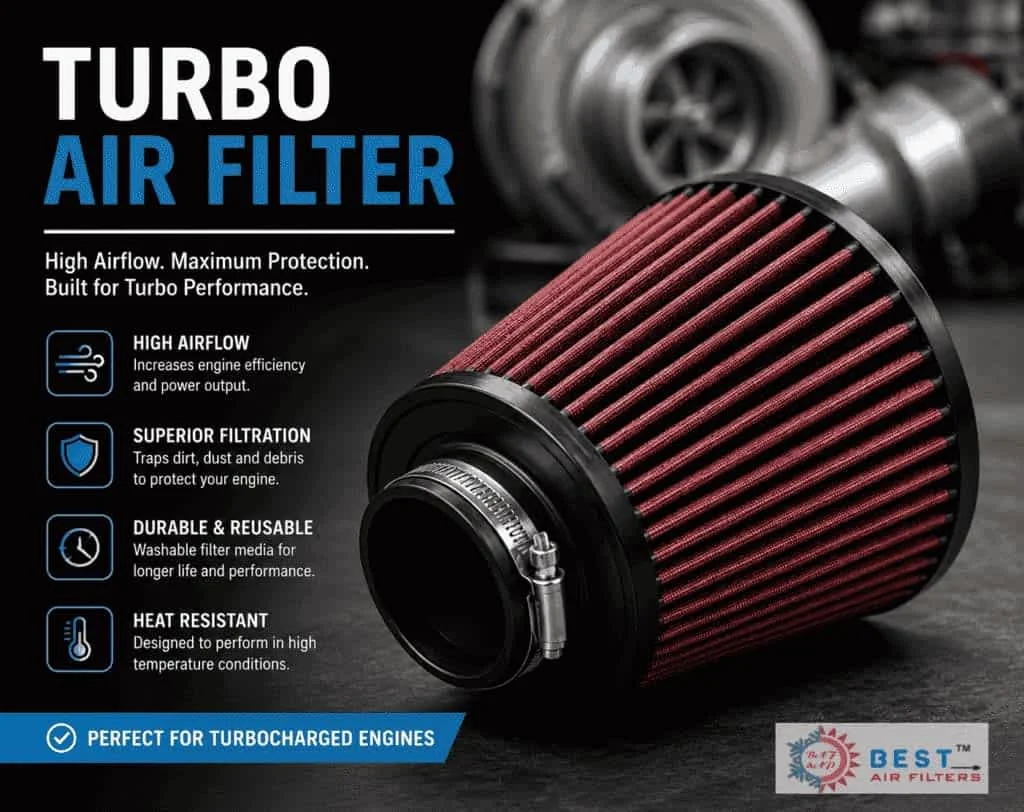
Turbo air filter vs turbocharger filter
Answer: “Turbo air filter” refers to the engine’s intake air filter on a turbocharged vehicle — not a separate filter inside the turbocharger itself.
The term also gets used loosely for performance air filters, cone filters, and aftermarket intake filters built for higher airflow. Some brands market a similar product as a “turbo guard,” which is usually a velocity-stack-style filter mounted close to the turbo inlet rather than in the factory airbox. It serves the same purpose as a cone filter, just under a different name. This article covers the engine intake side, which is what most people searching this term are looking for.
Why turbo engines need different air filtration
Answer: Because a turbo pulls a large volume of air in a short window under boost, and if the filter can’t supply that volume fast enough, restriction builds up on the intake side of the compressor — which can shorten turbo life.
A naturally aspirated engine pulls air at a fairly steady rate. Load changes, but the demand curve is gentle.
A turbocharged engine doesn’t behave that way. Under boost, the compressor wheel spins at high speed and pulls a large volume of air in a short window. If the filter media or housing can’t supply that volume fast enough, restriction builds up on the intake side of the compressor.
According to Garrett Motion, a turbocharger manufacturer, excessive intake restriction can lead to oil leakage from the compressor side piston ring, a higher pressure ratio across the compressor, and reduced turbo durability over time. Garrett recommends sizing the filter for a target face velocity of 130 ft/min or lower at the engine’s redline. That’s their guidance for their own turbos, and it’s a reasonable starting benchmark, though the right number for your specific turbo should come from its manufacturer’s spec sheet.
How to size a turbo air filter (worked example)
Answer: Convert mass flow to CFM, divide by your target face velocity to get the required filter area in in², then check that against the filter’s actual pleated area — if the filter’s area falls short, restriction goes up.
Garrett publishes the calculation behind that 130 ft/min number, and it’s worth walking through since it turns an abstract spec into a number you can actually use.
The formula has 3 steps.
- Find your volumetric flow rate (CFM). Volumetric flow rate = mass flow (lbs/min) / air density (lbs/ft³). For example, a mass flow of 40 lbs/min at an air density of 0.076 lbs/ft³ gives a volumetric flow rate of 526 CFM. For twin-turbo setups, divide this number by 2.
- Find the required filter area. Area (ft²) = CFM / face velocity (ft/min). Using 526 CFM at the 130 ft/min target: 526 / 130 = 4.05 ft², which converts to 583 in² (4.05 x 144).
- Check the filter’s actual area against that number. Filter area (in²) = pleat height x pleat depth x number of pleats x 2. A filter with a 9.00 inch pleat height, 0.55 inch pleat depth, and 60 pleats works out to 594 in², which clears the 583 in² requirement.
If your filter’s calculated area falls short of the required area, restriction goes up and the turbo loses access to the air it needs. This is the same math a turbo manufacturer runs before recommending a filter size, and it’s a useful check before buying rather than after.
How a turbo air filter actually works
Answer: Air passes through pleated media that traps dirt while letting clean air through; a turbo-rated filter adds more surface area and better heat isolation to keep restriction low at high flow.
Air enters through the filter media, which traps dirt, dust, and debris while letting clean air pass through to the turbo inlet. The media itself can be pleated paper, cotton gauze, or a synthetic foam layer, depending on the filter type.
What changes with a turbo-rated filter is surface area and flow path. More pleats or a larger cone shape gives the air more surface area to pass through, which lowers restriction at high flow rates. The housing (or lack of one) also matters. An open cone filter sitting in a hot engine bay pulls in air that’s already heated by the exhaust manifold or turbo housing, which reduces air density even if the filter itself flows well.
This is why two filters with the same CFM rating can perform differently in the real world. The rating tells you about the media. It doesn’t tell you about heat exposure, or how well the filter seals against the intake tube.
Types of turbo air filters
Answer: The four main types are panel, cone, oiled, and dry — the right one depends on your boost level, how much airflow gain you want, and how much maintenance you’re willing to do.
Panel filters
These fit inside the stock airbox and replace the factory paper element. They’re the easiest upgrade path because they keep the OEM housing, which usually means better heat isolation than an open filter. Good fit for mild turbo setups where you want a small airflow gain without changing the intake system.
Cone filters
These mount directly to the intake pipe, typically as part of an aftermarket cold air intake kit. They flow more air than a panel filter because of their exposed shape and larger surface area, but they’re also more exposed to underhood heat and road debris unless paired with a proper heat shield. A cone filter mounted low or facing forward is also more exposed to water splash and larger debris, which is why many builds add a dust cover, a mesh or fabric sleeve that fits over the filter to block coarse debris while still letting air through.
Oiled filters
Usually cotton gauze media coated in a light filter oil. The oil helps trap fine particles and the media flows well, plus the filter is washable and reusable over the life of the car. The tradeoff is real: over-oiling is one of the most common causes of MAF (mass airflow) sensor fouling, which throws off the engine’s air-fuel calculations and can cause rough idle or hesitation.
Dry filters
Synthetic or foam media with no oil required. Peak flow is usually a touch lower than a well-maintained oiled filter, but there’s no MAF contamination risk and less regular maintenance involved. For daily-driven turbo cars, this is often the lower-hassle choice.
Key specs to check before buying
Answer: Match CFM rating to your turbo’s max flow, balance micron rating against restriction, confirm exact fitment dimensions, and account for housing/heat exposure — in that order of importance.
CFM rating
Match this to your turbo’s maximum flow requirement, not your engine’s displacement alone. Two engines of the same size can need very different filter capacity depending on boost pressure and tune. If you don’t know your turbo’s max flow figure, your turbo manufacturer’s spec sheet or a tuner familiar with your setup can usually give you that number.
Micron filtration rating
A lower micron rating means the filter catches finer particles, but tighter filtration can also mean more restriction if the media area isn’t large enough to compensate. The right rating balances filtration efficiency against flow for your specific engine.
Fitment
Flange diameter, filter height, base and top diameter, and inlet size all need to line up with your turbo and the space available in your engine bay. Most manufacturers list these as exact dimensions rather than a single size name, so check the numbers rather than assuming a “3 inch filter” from one brand matches a “3 inch filter” from another. A high-flow filter that doesn’t seat properly against the intake tube will let unfiltered air bypass the media entirely, which defeats the purpose of the upgrade.
Housing and heat exposure
A filter with excellent CFM numbers on a flow bench can still underperform in your car if it sits exposed to engine bay heat. A heat shield or enclosed housing keeps the intake air closer to ambient temperature, which matters more for power output than most people expect, since denser (cooler) air makes more boost for the same throttle input.
Turbo air filter vs standard engine air filter
Answer: A turbo air filter is built and sized for peak, variable airflow under boost; a standard filter is sized for steady, moderate flow on a naturally aspirated engine.
| Factor | Turbo air filter | Standard engine air filter |
|---|---|---|
| Airflow rating | Sized for peak turbo demand (CFM-rated) | Sized for steady, moderate flow |
| Media | Cotton gauze, foam, or high-flow synthetic | Pleated paper |
| Reusability | Often washable and reusable (oiled types) | Usually disposable |
| Restriction under boost | Low, by design | Can restrict airflow under boost |
| Typical use | Turbocharged and boosted engines | Naturally aspirated engines |
Replacement intervals vary by vehicle, filter design, and driving conditions, so always follow the filter manufacturer’s inspection and service recommendations rather than a fixed number. As a general reference point, dry filters are commonly inspected or replaced somewhere in the 30,000 to 50,000 km range, and oiled filters are commonly cleaned somewhere in the 15,000 to 25,000 km range, but dusty or off-road driving can shorten both intervals significantly.
Choosing the right filter for your setup
Answer: Mild setups → stock-housing panel filter. Higher boost or full intake builds → cone filter with a heat shield, sized to your turbo’s inlet.
For a mild factory turbo setup or a light tune, a properly rated panel filter in the stock airbox is usually enough. You get a small airflow gain without giving up the heat isolation the factory housing provides.
For higher boost or a full aftermarket intake, a cone filter matched to your turbo’s inlet size makes more sense, but pair it with a heat shield if it’s going anywhere near the exhaust side of the engine bay. Track or high-boost builds tend to favor larger cone filters with more surface area, since restriction becomes a bigger factor as boost and flow demand climb.
If you’re unsure which category your build falls into, the honest answer is to check your turbo’s rated max flow and work backward from there rather than picking a filter based on looks or brand recognition alone.
Maintenance and replacement
Answer: Oiled filters need periodic cleaning and re-oiling; dry filters need periodic inspection and eventual replacement — both intervals depend heavily on driving conditions.
Oiled filters need periodic cleaning, followed by re-oiling per the manufacturer’s instructions. How often depends heavily on driving conditions, so treat any interval as a starting point rather than a fixed rule. Skipping this step reduces filtration efficiency over time as the media loads up with dirt.
Dry filters don’t need oiling, but they do need periodic inspection and eventual replacement once the media is visibly dirty or restriction starts to affect throttle response. There’s no universal number here since it depends heavily on driving environment. A car driven on dusty roads will need more frequent attention than one driven mostly on clean highway.
Common mistakes to avoid
Answer: The most common errors are over-oiling, sizing by displacement instead of CFM, prioritizing flow over fitment, and skipping the heat shield.
- Over-oiling an oiled filter. Excess oil migrates downstream to the MAF sensor and skews its readings, which shows up as rough idle or inconsistent throttle response.
- Sizing CFM by engine displacement alone. Boost pressure and tuning change the real airflow demand far more than displacement does.
- Prioritizing flow over fitment. A filter that flows well on paper but seals poorly against the intake tube lets unfiltered air past the media.
- Skipping the housing. An unshielded cone filter in a hot engine bay pulls in heat-soaked air, which lowers air density regardless of the filter’s CFM rating.
What to look for in a turbo air filter manufacturer
Answer: Look for tested (not estimated) CFM data, ISO certification, pressure-drop/micron data for the media itself, OEM cross-reference data, and custom sizing options.
Not every filter labeled “turbo” or “performance” is built to the same standard. A few things worth checking before you buy in bulk or for a specific application:
- Whether the manufacturer tests filters for actual CFM output, rather than listing an estimated number
- ISO certification for manufacturing quality control
- Pressure-drop and micron capture data for the specific filter media, not just the finished product
- OEM cross-reference data, so you can confirm fitment against your specific turbo or vehicle
- Custom sizing options, if your application doesn’t match a standard flange size or filter height
We’re a Delhi-based filter manufacturer with 10+ years of experience and ISO certification.
If you need a turbo air filter for a specific vehicle or engine, we manufacture across car air filters, two-wheeler air filters, and custom OEM sizes, and can work from your turbo’s flow rate and flange dimensions rather than a generic size chart.
Send us your turbo’s flow rate and flange dimensions, or the vehicle and engine details, and we’ll match a filter to that spec rather than a generic size chart. Get in touch with our team.
See also: Engine oil filter vs engine air filter | Automotive filters | Car air filter
FAQs
What is a turbo air filter?
It’s an air filter designed and rated for the higher, more variable airflow demand of a turbocharged engine, as opposed to the steadier flow a standard engine air filter handles.
Do turbo engines need a special air filter?
Not in every case, but any engine running meaningful boost benefits from a filter sized to its peak CFM demand. Mild factory turbo setups can often run a properly rated panel filter. Higher-boost or aftermarket builds usually need a cone or performance filter matched to the intake.
Oiled vs dry turbo air filter: which is better?
Oiled filters generally flow a bit more and are reusable, but carry a MAF fouling risk if over-oiled. Dry filters flow slightly less but need less upkeep and carry no oil contamination risk. The right choice comes down to how much maintenance you’re willing to do.
Can the wrong air filter damage a turbo?
It can, in two different ways. Excess intake restriction can raise the compressor’s pressure ratio and push the turbo toward overspeed, per turbo manufacturer guidance like Garrett’s. Separately, a filter that seals poorly lets unfiltered debris into the compressor, which causes physical damage over time.
How often should I replace a turbo air filter?
It depends on the filter type, your vehicle, and how dusty your driving environment is. As a rough reference, dry filters are commonly good for 30,000 to 50,000 km and oiled filters are commonly cleaned every 15,000 to 25,000 km, but always check your filter manufacturer’s specific recommendation first.
Is a turbo guard the same as a turbo air filter?
Mostly, yes. “Turbo guard” is a brand term some performance manufacturers use for a velocity-stack-style cone filter mounted close to the turbo inlet. It does the same job as a cone filter, just under different branding.
Do I need a dust cover on a cone filter?
If the filter is mounted low, forward-facing, or otherwise exposed to road spray and debris, yes. A dust cover is a mesh or fabric sleeve that fits over the filter to block coarse debris and water splash without meaningfully restricting airflow.
Need a turbo air filter for a specific application?
Send us your turbo’s flow rate and flange dimensions, or the vehicle and engine details, and we’ll match a filter to that spec rather than a generic size chart. Get in touch with our team.
See also: Engine oil filter vs engine air filter | Automotive filters | Car air filter